shadow
Victoria Woodhull & Company > Woodhull & Claflin's Weekly

Woodhull & Claflin’s Weekly Excerpts – Sep. 23, 1871

September 23, 1871

MY WORD ON ABORTION, AND OTHER THINGS.

By TENNIE C. CLAFLIN

I wish to say my word on the theme of the day—Abortion and the Abortionists. The immaculate New York press is just now suffering under one of those virtuous periodical spasms with which it is apt to be afflicted. Some woman has been found coffined in a trunk, her remorseful seducer has committed suicide, an abortionist has been arrested, another case occurs the next day, and, the next, a whole bevy of women are hunted to bay in a doctor’s shop of that order. The newspaper men are delighted. There is an immense flutter of agitation and excitement. The public is treated to a wonderful feast of sensation in the morning and evening papers. A fanfaronade is kept up, to last perhaps for near a week, over the awful subject; after which everything subsides into its usual routine, and goes on just as it went on before, and just as everybody knows that it is going on all the time.

Just as though abortion was not one of the fixed institutions of the country; one of the marked characteristics of the age, one of the indicative symptoms of the ripening and the rottening of our prevalent state of society!

Who proposes to disturb Madame Restel? Who really wants that there should be no opportunity to secure an abortion under peculiarly trying circumstances? A thousand gentlemen within the purlieus of Wall Street and Broad Street have occasion, within the year, to invoke the aid of the professionals in behalf of their female friends who have got into difficulty. A thousand women and girls, the friends of these gentlemen, and among them their own daughters, who are the friends of their friends, are saved to respectability by the same means. The shop of the abortionist is a beneficial institution, which protects the virtue and heals the heart sore of a thousand otherwise cursed and unfortunate families.

But the great revenue of these practitioners is from the married women among the wealthy. The lives of dissipation and senseless inanity which these women lead; the oppressions and disgusts of the marriage state; their hopeless and aimless lives; all together have so depressed the nervous energy of our women that they dread beyond endurance the burdens of child-bearing and the care of children. They have become unfit to have children, and abortion is the sewerage for this wretched stagnation of feminine life. . . .

My long practice from a mere child, as a magnetic physician and clairvoyant, has given me an insight, back of the scenes, into the sexual health conditions of both men and women, in this last phase of our existing civilization, which is truly fearful; and it is very sad that hardly anybody is even willing to know the truth about it. Most boys and many girls are already half ruined by secret solitary practices before the age of puberty. In the cities, nine-tenths of the young men complete their ruin and introduce wretchedness and death into their subsequent families by contracting syphilitic diseases. Abortion before marriage and especially after marriage are the rule rather than the exception—in the wealthy and fashionable classes, and to a great extent among workingwomen who say they “can’t afford to have children.” Many women learn to practice it on themselves, and many of them have repeated it dozens of times; and unprofessional gentlemen by the score, boast confidentially to their friends that “they can do it as well as the doctors.” The majority of women, as a result of all these causes, and other faults in our methods of living, have the abominable fluoralbus, and even little girls are dying by the hundred from diseases which in other ages of the world were only known, if at all, among the most debauched and profligate women.

Abortion is only a symptom of a more deep-seated disorder of the social state. It cannot be put down by law. Normally the mother of ten children is as healthy, and may be as youthful and beautiful, as a healthy maiden. Child-bearing is not a disease, but a beautiful office of nature. But to our faded-out, sickly, exhausted type of women, it is a fearful ordeal. Nearly every child born is an unwelcome guest. Abortion is the choice of evils for such women.

Is there, then, no remedy for all this bad state of things? None, I solemnly believe; none, by means of repression and law. I believe there is no other remedy possible but freedom in the social sphere. I know that it looks as though this were going in the direction of more vice. Conservatives always think that freedom must conduce to licentiousness; and yet freedom has a way of working out the evils begotten by the previous slavery, and its own evils also. Freedom is a great panacea. It will be when women are thrown on their own resources, when they mingle on more equal terms with men, when they are aroused to enterprise and developed in their intellects; when, in a word, a new sort of life is devised through freedom, that we can recover the lost ground of true virtue, coupled with the advantages of the most advanced age.

It will be, especially, when Physiology is freely taught to women, when they are made to understand the mechanisms and liabilities of their own systems, that the true remedy will begin to be applied. Now the young girl is sedulously kept in ignorance by her own mother of everything of this sort that she should be taught in the right way to know, and she learns it with avidity in the wrong way, from the most prurient of her school companions. Nature has implanted the desire for the knowledge, and withheld by the natural guardian, it is greedily absorbed at the boarding school or in the street.

And the freedom to be healthy must be absolute. As long as woman can be crushed by an imputation of impropriety, she will remain virtually a slave. It will not be until the worst word of vituperative slang which the world can heap on a woman shall lose its terror for her who is conscious of being true to herself that woman will be free to develop her own destiny in accordance with the designs of her being. As long as there is one remaining word in the vocabulary of Phariseeism and repressive insolence which can be hurled at her, and which she fears, she will not be free to begin the life of regenerated humanity which must save society ultimately from its social evils. Freedom is the first condition of all genuine, thorough investigation, and we are too deeply involved in the wretched results of the old order of things, to hope to escape without the most searching and all-sided investigation—which will require the free and enlightened and fearless cooperation of women, as well as of men.

Webmaster’s Note: These are actual extracts from the Woodhull & Claflin’s Weekly. Victoria Woodhull shared her sister’s opinion that abortion should not be addressed by repressing it by law, but by giving women more social and economic freedom.

JANFEBMAR
January 20, 1872
January 27, 1872
February 3, 1872
February 10, 1872
February 17, 1872
February 24, 1872
March 2, 1872
March 9, 1872
March 16, 1872
March 23, 1872
March 30, 1872
APRMAYJUNE
April 6, 1872
April 13, 1872
April 20, 1872
April 27, 1872
May 4, 1872
May 11, 1872
May 18, 1872
May 25, 1872
June 1, 1872
June 8, 1872
June 15, 1872
June 22, 1872
June 24, 1871
JULYAUGSEPT
July 1, 1871
July 2, 1870
July 8, 1871
July 15, 1871
July 22, 1871
July 29, 1871
August 5, 1871
August 12, 1871
August 19, 1871
August 26, 1871
September 2, 1871
September 9, 1871
September 16, 1871
September 23, 1871
September 30, 1871
OCTNOVDEC
October 7, 1871
October 14, 1871
October 21, 1871
October 28, 1871
November 2, 1872
November 4, 1871
November 15, 1873
November 18, 1871
November 25, 1871
December 2, 1871
December 9, 1871
December 16, 1871
December 23, 1871

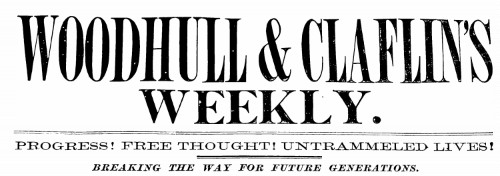
When this web site began in September 1999, there were no digitized copies of Woodhull & Claflin’s Weekly available online. Now you can find an almost complete run on the IAPSOP web site which has no affiliation with Victoria Woodhull & Company:
Woodhull & Claflin’s Weekly at IAPSOP

Woodhull & Claflin’s Weekly Excerpts – Sep. 16, 1871

Sept. 16, 1871

[Page 8]

THE SOCIAL VOLCANO.

Another of those periodical volcanic upheavals has taken place, demonstrating the false sense of propriety which permeates the humanity of today, and wakes up momentarily the slumbering community to a realization of the state of affairs existing in the every day life and practice of everyday people. Is it not strange that the public at large will steadfastly refuse to look at the stern logic of fact—will ignore the principles underlying the social problems of today—until some poor unfortunate who lives off the endeavors of persons to hide acts which their very natures prompt (but which the false opinions of society compels them to hide) forces attention to their own sins. This is the case with the celebrated “trunk tragedy.” Poor Alice Bowlsby lies in the Potter’s Field; a martyr to the outrageous opinions of the unthinking, who set up a standard of virtue which no man endeavors to follow, and which it is no sin in any man to evade privately.

We lay the death of Alice Bowlsby, of Walter Conklin and the deed of [abortionist] Doctor Rosenzweig at the door of society. We bring the dead bodies of the father, mother and the unborn child and lay them on society’s doorstep, saying, “Behold your handiwork.” This is no time to be scrupulous in our language. We cannot stand to pick words which hundreds are running the risks which Miss Bowlsby ran to satisfy the laws of society. We say that society itself is the patron of abortionists, that society’’ present laws make their occupation excusable, nay, a necessity; that the very men who are so loud in their denunciations of Rosenzweig and his class have, nine out of every ten of them, paid for his assistance, and, among women, nine out of ten would act as Alice Bowlsby did, if placed in the same position.

Ladies and gentlemen, you cannot carry out your social system; you have taught it in your schools, at your firesides, in your churches; you have made it a tool of respectability; you visit the deepest, the blackest, the direst of punishment upon all who transgress your rule, and yet you fail. The sons and daughters who have been reared in its atmosphere, ignore it; they cannot act up to it, and as regards the male portion, you do not dare to attempt to enforce it. All you dare do is to exact that they hide it as much as possible.

Your social civilization is a failure, and you know it, yet you say, “hush, don’t say anything about it.” There are scores of abortionists in this city alone, some worth millions. Where did they get it? Working girls cannot afford the hundred dollars necessary to employ a Rosenzweig, therefore it is, of course, upper tendom who supports them, aye, makes their immense fortunes while paying their enormous advertising bills.

You screech at Rosenzweig today; you employed him yesterday, and will produce patients for his successor tomorrow, and go to church next Sunday and look as devout as a Chadband. And yet, as society exists, he has been your friend. How many of your daughters owe the shelter of your roofs to him? Ah! were that question fairly solved, it would ignite a torch whose lurid glare would inflame this city from end to end, and every one would proclaim how dreadfully bad his neighbor was, and point out the skeleton in his neighbor’s closet.

You may execrate Rosenzweig, but you cannot hide the fact that his labors are a necessity so long as your social system endures. You create the demand for his occupation and supply the material for it. Here is a fair consideration of the facts of the case.

You have erected a social system which you teach from childhood to manhood, which you inculcate at home, at school, at church, and in all your social relations. Yet the victims are made daily in spite of the inhuman punishment you inflict for a non-compliance with your standard. Now in dealing with your system, we say here are a hundred victims; if they have no means of escape, at least ten will commit suicide, at least fifty will be driven from home into the streets, and the remainder will have the finger of scorn pointed at them so long as they live, while ninety children will be brought into the world under a ban of shame, which the better men they become, the harder will that ban be to bear, the deeper will it sink into their heart, although they had no control over the circumstances that make them degraded for life.

The Rosenzweigs step in and say, practically, “I will spare you nine deaths out of the en (for only one in a hundred dies under my hands). I will send fifty more out of the hundred victims home, still virtuous according to your rules, because no one knows of the so-called transgression, and the remainder shall have their error known only to their parents or relatives, and the outside world and future husbands shall remain in happy and blissful ignorance of the truth. All this I will do for one hundred dollars each.” You find the money, you have the private interview with Rosenzweig (not that you are interested; oh, no, it is all out of pure friendship; you didn’t do it; it was some other man.) You cheat society’s rules of its victims, until another victim dies. Then you howl at their depravity and Rosenzweig’s villainy.

These facts cannot be evaded; look them in the face; they invite you daily, even in the daily papers, where the advertisements are blazoned forth, ending, “Dr.—– doesn’t humbug ladies with medicine. Private rooms for nursing and children adopted out.”

But of course you don’t read these, or turn up your dainty noses at them until you have a case on hand.

Rosenzweig’s case will soon be forgotten; all will run on as before until the next trunk turns up, and some other unfortunate fails to successfully perform the task you engaged him to perform—and so wags the world.

Webmaster’s Note: These are actual extracts from the Woodhull & Claflin’s Weekly. Sentences or paragraphs that have been removed are indicated with the ellipsis (….)

JANFEBMAR
January 20, 1872
January 27, 1872
February 3, 1872
February 10, 1872
February 17, 1872
February 24, 1872
March 2, 1872
March 9, 1872
March 16, 1872
March 23, 1872
March 30, 1872
APRMAYJUNE
April 6, 1872
April 13, 1872
April 20, 1872
April 27, 1872
May 4, 1872
May 11, 1872
May 18, 1872
May 25, 1872
June 1, 1872
June 8, 1872
June 15, 1872
June 22, 1872
June 24, 1871
JULYAUGSEPT
July 1, 1871
July 2, 1870
July 8, 1871
July 15, 1871
July 22, 1871
July 29, 1871
August 5, 1871
August 12, 1871
August 19, 1871
August 26, 1871
September 2, 1871
September 9, 1871
September 16, 1871
September 23, 1871
September 30, 1871
OCTNOVDEC
October 7, 1871
October 14, 1871
October 21, 1871
October 28, 1871
November 2, 1872
November 4, 1871
November 15, 1873
November 18, 1871
November 25, 1871
December 2, 1871
December 9, 1871
December 16, 1871
December 23, 1871

When this web site began in September 1999, there were no digitized copies of Woodhull & Claflin’s Weekly available online. Now you can find an almost complete run on the IAPSOP web site which has no affiliation with Victoria Woodhull & Company:

Woodhull & Claflin’s Weekly at IAPSOP

Woodhull & Claflin’s Weekly Excerpts – Sep. 9, 1871

September 9, 1871

[Page 14]

WOMAN ITEMS.

…Donn Piatt, or someone else in the Capital, objects to ladies wearing corsets beneath a loose muslin wrapper in hot weather. First, how does he know? Secondly, whose funeral is it?…

A Boston lady has started a society to do away with false forms of speech. Instead of “Ah, dear; how glad I am to see you,” of polite society, the new formula will be, “Cuss yer. Git out.”

Horace Greeley’s advice to women to learn how to cook a steak, and not to mind suffrage, is good under circumstances. But without the steak the knowledge to cook it is valueless. This is where the suffrage will come in….

FROM MRS. DAVIS.

PROVIDENCE, August 26.

MY DEAR VICTORIA: Despite the Tribune’s idea of my idleness and ennui I find every hour so filled with duties that friendly letters are often deferred, not wholly neglected, for I usually bring up at the last moment. This must be my excuse for not having sooner congratulated you upon your nomination by the VICTORIA LEAGUE to the Presidency. But I have not been either idle or unmindful of our, your interests, for in the one I consider the other bound up.

From the time when I picked up your paper with your name at the head as the future President of the U.S.A., and read your pronunciamento, I have never named any other candidate for President.

That step at once proved you fearless, self-sacrificing and strong in the right. Your platform of a just government I regard as a most able state paper, one that will bear a favorable comparison with any which has been put forth for years; and I am proud that it is bound up with the history of the first twenty years’ work for human freedom. It is a most excellent beginning of the history of the next decade.

The meeting held in Apollo Hall, though seemingly so near a failure, has certainly not been without its results. If there had been no other, the issuing that one document (though not endorsed, as it should have been, by the meeting) would have been worth the time; but the great social question receives an impetus that it will not soon lose in its onward progress. I believe people begin to see that suffrage will not give woman social equality any more than it gives it to the negro now; it is but a stepping-stone toward the greater. The black man votes, but ask him if he does not still feel the ban of public sentiment against his tinted skin, and he will answer yes; and sex will still be the word to stifle woman’s aspirations for a larger life, even though she may vote for years.

Though as a scientist, I regard the social questions as of the greater importance, I am none the less ready to accept your nomination; and though I may be on the other side [of] the globe, I shall come home to vote for you in 1872; and every woman will be recreant to duty who fails in standing firmly in this crisis by your side, strengthening, encouraging and aiding in all and every possible way.

Yours ever truly, PAULINA W. DAVIS

Webmaster’s Note: These are actual extracts from the Woodhull & Claflin’s Weekly. Sentences or paragraphs that have been removed are indicated with the ellipsis (….)

JANFEBMAR
January 20, 1872
January 27, 1872
February 3, 1872
February 10, 1872
February 17, 1872
February 24, 1872
March 2, 1872
March 9, 1872
March 16, 1872
March 23, 1872
March 30, 1872
APRMAYJUNE
April 6, 1872
April 13, 1872
April 20, 1872
April 27, 1872
May 4, 1872
May 11, 1872
May 18, 1872
May 25, 1872
June 1, 1872
June 8, 1872
June 15, 1872
June 22, 1872
June 24, 1871
JULYAUGSEPT
July 1, 1871
July 2, 1870
July 8, 1871
July 15, 1871
July 22, 1871
July 29, 1871
August 5, 1871
August 12, 1871
August 19, 1871
August 26, 1871
September 2, 1871
September 9, 1871
September 16, 1871
September 23, 1871
September 30, 1871
OCTNOVDEC
October 7, 1871
October 14, 1871
October 21, 1871
October 28, 1871
November 2, 1872
November 4, 1871
November 15, 1873
November 18, 1871
November 25, 1871
December 2, 1871
December 9, 1871
December 16, 1871
December 23, 1871

When this web site began in September 1999, there were no digitized copies of Woodhull & Claflin’s Weekly available online. Now you can find an almost complete run on the IAPSOP web site which has no affiliation with Victoria Woodhull & Company:

Woodhull & Claflin’s Weekly at IAPSOP

Woodhull & Claflin’s Weekly Excerpts – Sep. 2, 1871

Sept. 2, 1871

[Page 14]

WOMAN ITEMS.

From Utah we learn that divorce cases are not numerous in the courts nowadays.

Miss Clara Barton is in France, visiting the devastated districts, and looking after the necessities of the
people.

Brigham is wiser than Bingham. Women voted by the wagon load in Brigham City agreeably to the order of old “Polg.”

“Howard Glyndon,” of the New York Evening Mail, is almost stone deaf, but is a dapper, bright-eyed and smart little woman, for all that.

Mrs. Mary Ann Cleveland, of Maquoketa, Iowa, has sued ten saloon-keepers of that city for $5,000 damages done her by furnishing liquor to her husband….

A Pittsburgh girl slept twenty-two days, then arose, ate two pies, and abused her friends because they teased her “for oversleeping an hour in the morning.” They told her that it was lucky that they hadn’t buried her….

The sister of Delescluze, the famous Communist, now in her sixty-fifth year, is to be tried by a council of war at Versailles on various charges. She is said to have been a Petroleuse, and to have murdered several of the troops of Thiers.

Rev. T De Witt Talmadge says that women have a right to do everything which they can do well. Certainly; but if men were permitted to do only that which they do well, what a host of poor fellows would be thrown out of employment….

[Page 4]

 KARL MARX, FOUNDER OF THE INTERNATIONAL LEAGUE.

The Leipsic Grenzboetem, a journal hostile to the policy of the International League, gives the following account of the career of the founder of that association:

Before 1848 Communism was little more than the dream of a sect closely. After the revolutionary agitation of that year had somewhat subsided, a fusion was accomplished at London at between two distinct elements, one of which was the hatred of certain eccentric individuals for the existing state of things, and the other the instinctive and chimerical longing of the working classes to put themselves in the place of those who govern and enjoy, in order to enjoy and rule in their turn. Charles [sic] Marx, a native of Rhenish Prussia, and a Jew by birth, began the realization of this utopian vision by placing himself at the head of a vast conspiracy, designed to create practical Communism. From that moment this sect became the most powerful of all the secret societies. London had harbored for several years previously a crowd of proscribed individuals who fretted with impotent rage and constantly brooded over the causes of their exile. Charles Marx succeeded in turning these personal grievances to account in the interest of his association. Each group of exiles had its own favorite theory, and most of these theories bore a separate character, but they were all tinged with the errors, hallucinations and national tendencies of the individuals who entertained them. It was still necessary to find a universal lever which might be everywhere applied and utilized with facility. This lever Marx found in the chronic discontent of the working classes.

He founded a secret association, independent of any consideration of nationality or government, comprehending that it would be a more arduous task to carry out a particular than a universal conspiracy, since the capabilities of the former would be necessarily much more restricted than those of the latter he consequently endeavored to agglomerate, as far as practicable, the elements of discontent scattered through the civilized world. He succeeded in gaining for his cause of the most resolute and vehement, the instruments best adapted for his purpose, and of them he composed his staff. The next step was to form an army of the malcontent workman of all countries. To attain this end he organized a system of emissaries, traveling agents, and open or private agitators. A central management was established, which, by means of an ingenious system of ramifications, regularly corresponded with all the members of the body. Thus rose at the International League. Its object is to abolish production by the agency of capital–that is, the factors of production are to be divested of the character of individual property; the producing elements–things, persons and talents–shall belong to everyone alike It will appertain to the official representatives of the Commune to direct the employment of the common powers and resources, and to distribute the product among all. But how is the Commune to be constituted? Apparently by means of small communities of workmen, who, by uniting, will, in their turn, form a larger one, and eventually the great universal community itself. Each of these minor communities is governed by a sort of a dictator, and the whole association is subjected to the control of a supreme head, who may be called the dictator-general. All these chiefs are chosen by means of election.

It is evident that, in order to arrive at the abolition of production by capital, the State, as it at present exists, must perish, with all the principles on which it is founded. Charles Marx is at once a deep thinker, and to a certain extent a practical man. He considered there was only one possibility of carrying out his project, and that would be furnished by a great war. Under cover of the confusion and disorganization which, he assumed must thus arise, and aided by the stagnation of business–a prolific source of discontent–he calculated on obtaining possession, by means of his army, of one or several of the great European states. When once a revolution of the proletariat had triumphed on the continent, the workmen of England were to revolutionize their own country. It is remarkable that Marx, in a book on capital, which he published a few years ago, but had composed a good while before, even then anticipated the probable triumph of a revolt by workmen. In this book he dwells more particularly on the spirit diffused among the English working classes were by the old American war, and he draws the following parallel: “Just as the War of Independence waged by the American colonies produced in the last century the French Revolution, in a similar way the overthrow of the slaveholders will be next followed in Europe by that of the possessors of capital.”

It cannot be doubted that in 1866 Marx would have taken advantage of the Austro-Prussian War to organize a proletariat insurrection, had campaigned not terminated so rapidly as it did. Once again, however, his plans were frustrated by the extreme rapidity of the German victories. The result of the great events of 1870 was to enhance the sentiment of nationality in Germany, and to inflame the national pride of the French; hence the moment was not propitious for socialistic enterprise, and the League was unable to effect anything of importance until it was too late–till the chosen champions of Socialism had been armed for the defense of the capital. They hope to secure the victory of the League in France and maintain peace as long as possible with Germany, in the expectation of some day destroying German nationality and the German government by the internal disorders that they had prepared and fomented, as a machine may be exploded by an overcharge of steam. Such were probably the designs of the invisible Chiefs of League, and this program has been, to some extent, faithfully executed by their uninitiated followers. When it was evident that the Versailles government could not be overthrown by armed force, the League is set Paris in flames to let its victorious adversaries understand with what an enemy they had to do—an enemy which, though beaten and massacred, always and everywhere arises revivified from its ashes.

Webmaster’s Note: These are actual extracts from the Woodhull & Claflin’s Weekly. Sentences or paragraphs that have been removed are indicated with the ellipsis (….)

JANFEBMAR
January 20, 1872
January 27, 1872
February 3, 1872
February 10, 1872
February 17, 1872
February 24, 1872
March 2, 1872
March 9, 1872
March 16, 1872
March 23, 1872
March 30, 1872
APRMAYJUNE
April 6, 1872
April 13, 1872
April 20, 1872
April 27, 1872
May 4, 1872
May 11, 1872
May 18, 1872
May 25, 1872
June 1, 1872
June 8, 1872
June 15, 1872
June 22, 1872
June 24, 1871
JULYAUGSEPT
July 1, 1871
July 2, 1870
July 8, 1871
July 15, 1871
July 22, 1871
July 29, 1871
August 5, 1871
August 12, 1871
August 19, 1871
August 26, 1871
September 2, 1871
September 9, 1871
September 16, 1871
September 23, 1871
September 30, 1871
OCTNOVDEC
October 7, 1871
October 14, 1871
October 21, 1871
October 28, 1871
November 2, 1872
November 4, 1871
November 15, 1873
November 18, 1871
November 25, 1871
December 2, 1871
December 9, 1871
December 16, 1871
December 23, 1871

When this web site began in September 1999, there were no digitized copies of Woodhull & Claflin’s Weekly available online. Now you can find an almost complete run on the IAPSOP web site which has no affiliation with Victoria Woodhull & Company:

Woodhull & Claflin’s Weekly at IAPSOP

Woodhull & Claflin’s Weekly Excerpts – Aug. 26, 1871

August 26, 1871

[Page 14]

WOMAN ITEMS.

…The capacity of women to bear arms, which has been urged against their claims to political citizenship, was fully tested in Paris during the late reign of the Communists….

“Warrington” of the Springfield Republican, says “that it seems to be the object of certain women, among whom Mrs. Stowe and Gail Hamilton are conspicuous, to vie with the most abusive of the men in running down their sex.”…

The women of a certain town in Ohio took it upon themselves recently to close the gin mills, and, assembling in squads, they betook themselves to the taverns, and quietly sat down with their knitting the whole day, working and talking unconcernedly. Husbands and brothers came in unawares, and of course did not drink under such circumstances, and the reform has proved lasting.

A Bristol man undertook the other day to punish his daughter, a girl of eighteen, for accepting the attentions of a young man whom he didn’t like. The girl very naturally objected to this sort of interference in her love affairs, whereat the fond parent let fly his fist and knocked two of her teeth down her throat. A local magistrate let the brute off with a fine of $5. Justice is a funny thing, sometimes, in Connecticut, as well as other places….

FREE LOVE.

To the Editor of the N.Y. Tribune.

SIR: During some five or six years past, and especially of late, the Newspaper Press has made free use of my name in connection with what it denominates the Doctrine of Free Love. Every variety of interpretation has been put upon my opinions, usually the least favorable which the imagination of the writer could devise, with a view, apparently, of cultivating still further the natural prejudice existing in the public mind against any one bold enough to agitate the delicate and difficult question of the true relations of the sexes, and the legitimate role which the Passions were intended to play in the economy of the Universe. During the same period, I have allowed the Press to make what havoc it pleased of my reputation, uttering no word of explanation or reply, for the reason that neither Press nor People were, as I believe, prepared to do justice in the premises, and I preferred to “bide my time,” rather than seek or accept the stinted half justice which I might, perhaps, have supplicated and obtained. Most or all of my co-doctrinaires have pursued the same course. Two results have followed. First, in the absence of any readiness on the part of the public to know the truth on the subject, false, extravagant and ridiculous notions have flooded the country in its stead; secondly, in the absence of any opportunity for a judicious popular advocacy of Social Freedom, and despite abuse, the doctrine itself has made unprecedented progress, until at this day its advocates are numbered by thousands, while there are included among them an unusual proportion of the wealthy, intelligent and refined….

America, and through it, the world, have been recently startled, shocked and horrified even, by the announcement of a new freedom, the Freedom of Love. It may be well to reflect that every new idea, fraught with any genuine greatness or value, has, in other times, startled, shocked and horrified the public in whose ears it was first uttered, and to inquire whether we, in one day, may not be, perchance, repeating the same ridiculous farce, the nightmare of the world’s infancy, the panic of ignorance and “verdancy,” with which the race has always hitherto accorded a reception to every new dispensation of truth.

Is there anything to terrify the imagination in the idea of Freedom? Is not freedom already recognized and worshipped as a goddess, and her image stamped upon the coin of the realm? Is it Love that is viewed as a monster, whose very name paralyzes with fear? There are ancient writings, not a little revered among us, which declare that “Love is the fulfilling of the law,” and again, that “God is Love.” How, then, does it happen that Free Love, of the Freedom of Loving Hearts, should be a word of terror to mankind, so that the world forgets her propriety, and is made to misbehave herself, with unseemly alarm, at the mere mention of an entymological combination the elements of which, uttered separately, fall with the soothing cadence of a lullaby upon the same excitable nerves.

Free Love is simply the antithesis of enslaved Love. This is equally true in all the senses of which the word is susceptible, whether confined to the amative and sentimental relation of the sexes, or enlarged to signify the whole affectional nature of man.

In beginning an agitation for the emancipation of the human race from the tyranny which prescribes what it is lawful for them to fell, the writer of this intended the freedom of the whole range of the affections, and adopted, as the technicality to express that idea, the term “Freedom of the Affections.” . . .

Without restraining the meaning of the word to the relations of the sexes, it is admitted that those relations are included and mainly intended by it, and that the freedom proposed contemplates the entire abolition of the institution of Marriage as a legal tie to be maintained and perpetuated by force.

The first popular objection to Free Love, to be anticipated as existing in the public mind, is the prevalent belief that the Bible has prescribed an indissoluble monogamy, or the life-marriage of one man and one woman, as the only form of the union of the sexes which God approves. This belief results from the interpretation which some of the words of Christ in relation to marriage have almost uniformly received….The Scriptures have been held, at various periods with equal unanimity, to teach that the sun revolves around the earth; that kings reign of divine right, and must not, for any cause, be resisted; and that the world was created in six literal days. With the progress of astronomy, politics and geology, each of these convictions has given way before the scientific discovery of adverse facts and principles….

In this country; and in this age, we have, in one sphere of social affairs, a successful and triumphant practical illustration of the theory that the recognition of the rights of the individual is the talisman of order and harmony in society….Not only is he permitted “to worship God according to the dictates of his own conscience,” but, equally, to neglect or refuse to worship Him altogether; and the result is peace and fraternity; in the place of the inquisition, the burning fagot and war.

For one, I reject and repudiate the interference of the State in my morals, precisely as I do the interference of the church to prescribe my religious deportment or believe. The outrage on human rights is in my view no less in kind to assume to determine whom men and women may love, and what manifestation they may make of that sentiment, than it is to burn them at Geneva or Smithfield for heretical practice or faith.

Such, then, is Free Love—neither more nor less. It is simply a branch or single application of the larger doctrine of the Sovereignty of the Individual. It decides absolutely nothing with regard to the form or continuity of the love relation. Whosoever believes that the parties immediately concerned are the proper parties to determine the form and duration of that relation; whosoever wishes to discard legislative enactments, and adopt a “higher law” as the appropriate regulator of affairs of the heart, is, a Free Lovite, no matter what he expects will be the result as the operation of that law.

The attempt to degrade Free Love into the partisanship of an unbridled licentiousness is partly the result of an honest confusion of ideas, and partly the effect of natures conscious as yet of no greater elevation of sentiment in themselves than the promptings of unregulated desire. This fog will rapidly disappear….

[T]he second grand objection to freedom in this application, an objection also founded upon a popular religious dogma—namely, the belief that man is, in himself, radically bad. Under this belief the passions, especially, are abused as infernal and diabolical. No belief ever held by mankind is so essentially anti-progressives as this….

The third and last grand objection to Amorous Liberty relates to the maintenance and culture of Children. This objection assumes that the isolated family offers the only mode of properly caring for offspring. The family, as now constituted, is, in fact, a very hot-bed of selfishness, which, while it provides for one’s own children badly enough, permits the children of others, equally good, to starve at one’s door, with the comfortable assurance that the responsibility belongs with someone else. A grand social revolutions is soon to occur. In this generation THE PEOPLE float in palaces upon their rivers and bays; in the next they will live in palaces upon land. Then the nursery will be a Unitary Institution, scientifically organized and adapted to the new social state. Let the reader refer, upon this subject, to a tract called “The Baby World.”

Finally, the words Free and Freedom are everywhere honored, except in the connections “Free Ni**ers,” “Free Women,” “Free Thinking” and “Free Love.” They are scoffed at in those relations because they stand opposed to Tyrannies that are still respectable—Slavery, Marriage and the Authority of the Church. When Tyranny of all kinds shall have disappeared, Freedom of all kinds will be revered, and none will be ashamed to confess that they believe in the Freedom of Love.

STEPHEN PEARL ANDREWS

Webmaster’s Note: These are actual extracts from the Woodhull & Claflin’s Weekly. Andrews repeated a racial slur used by supporters of slavery. For sensitivity, I added asterisks while preserving the historical context. Sentences or paragraphs that have been removed are indicated with the ellipsis (….)

JANFEBMAR
January 20, 1872
January 27, 1872
February 3, 1872
February 10, 1872
February 17, 1872
February 24, 1872
March 2, 1872
March 9, 1872
March 16, 1872
March 23, 1872
March 30, 1872
APRMAYJUNE
April 6, 1872
April 13, 1872
April 20, 1872
April 27, 1872
May 4, 1872
May 11, 1872
May 18, 1872
May 25, 1872
June 1, 1872
June 8, 1872
June 15, 1872
June 22, 1872
June 24, 1871
JULYAUGSEPT
July 1, 1871
July 2, 1870
July 8, 1871
July 15, 1871
July 22, 1871
July 29, 1871
August 5, 1871
August 12, 1871
August 19, 1871
August 26, 1871
September 2, 1871
September 9, 1871
September 16, 1871
September 23, 1871
September 30, 1871
OCTNOVDEC
October 7, 1871
October 14, 1871
October 21, 1871
October 28, 1871
November 2, 1872
November 4, 1871
November 15, 1873
November 18, 1871
November 25, 1871
December 2, 1871
December 9, 1871
December 16, 1871
December 23, 1871

When this web site began in September 1999, there were no digitized copies of Woodhull & Claflin’s Weekly available online. Now you can find an almost complete run on the IAPSOP web site which has no affiliation with Victoria Woodhull & Company:

Woodhull & Claflin’s Weekly at IAPSOP

Woodhull & Claflin’s Weekly Excerpts – Aug. 19, 1871

August 19, 1871

[Page 14]

WOMAN ITEMS.

…A girl who is now called a “beautiful blonde,” would a few years ago have been termed “a tow head.” Such is life….

 When a Chicago girl quarrels with her lover, she communicates the important fact to her friends in the remark that she “isn’t on squeezing terms with that fraud no more.”…

[Page 7]

THE WESTFIELD EXPLOSION

“Men must work, women must weep,” is not cheery doctrine. Yet it seems true. The investigation into the steamboat accident results in no satisfactory solution of the problem. The opinions of experts are as wild and as inconclusive as the opinions of “experts” always are. Indeed, experts seem specially designed, not to elucidate, but to befog. The boiler was good and it was bad; it was cracked and it was sound; it rent from the top to the bottom, although it rent from the bottom to the top. It is perfectly sure that there was too little water, if it were not equally certain that there was a sufficiency of water. One thing is certain and no one contradicts that. The boiler exploded. The second point of accord is that gauges are, like some other inventions, “mighty onsartain.” Thirdly, that the engineer is, as a third-class man, incompetent at all times, and off his post at the time in question. Lastly, that steam generates very rapidly, and that if there be one moment more than another when care is specially required, it is when the boat is standing still getting up steam for a new start. Were the owners to blame? Owners are always to blame in case of accident. As common carriers all railroad and steamboat owners promise to carry the passengers safe and sound, and to deliver them at their journey’s end in good order and condition. The legal responsibility is beyond all doubt or cavil. The moral responsibility is that everything that can be done ought to be done, both by proprietors and employes, for the comfort and safety of passengers; instead of which passengers are usually considered as freight—goods, cattle or humans—it is all one to the carrier; it’s only freight. Human souls or bodies, their pleasure, their comfort or their awful agony is of no account to the carrier. If a third-class engineer or a patched boiler or a rusty gauge will do as well as the better article, let it go. The easiest way is the best way. It’s the passenger’s lookout. If he don’t want to be smashed he needn’t go by this route; if he dislikes being scalded or burned or crushed to death he can take the other boat or stop at home. We owners are only traders and dealers. We sell the goods we have at the best profit we can get. Let the purchaser look out.

No amount of money will compensate for the infliction of torture, and most likely the owners of the Westfield would go down under the mass of damages they will have to pay, as they certainly ought under the weight of public opprobrium for miserable parsimony and indifference to their public duty. But it is a very great pity that the law, instead of making them answerable in money damages, should not make them responsible to the people as criminals. A petty theft of a pound of steak would subject the miserable, hungry offender to months of imprisonment; the infamous dereliction of the most solemn civil duty perpetrated by men of intelligence and position in the pursuit of wealth and self-aggrandizement leaves them intact, except to the nominal penalties of commercial insolvency.

Over and above the question of owners’ responsibility comes the question of official and supervisory responsibility. Of course, now all the inspectors will rush to inspect all the hulls and boilers and to regulate everything. Every neglectful delinquent shakes in his boots lest his name should be published for being off his post. But after the flurry we shall all go to sleep again, until awakened by the next accident; and so on until we have a new regime of government, in which duty done will be of more account in public estimation than duty shirked or money made.

The people have it in their own hands, but they prefer occasional accidents to the perpetual bother of popular vigilance and official responsibility.

Webmaster’s Note: These are actual extracts from the Woodhull & Claflin’s Weekly. Sentences or paragraphs that have been removed are indicated with the ellipsis (….)

JANFEBMAR
January 20, 1872
January 27, 1872
February 3, 1872
February 10, 1872
February 17, 1872
February 24, 1872
March 2, 1872
March 9, 1872
March 16, 1872
March 23, 1872
March 30, 1872
APRMAYJUNE
April 6, 1872
April 13, 1872
April 20, 1872
April 27, 1872
May 4, 1872
May 11, 1872
May 18, 1872
May 25, 1872
June 1, 1872
June 8, 1872
June 15, 1872
June 22, 1872
June 24, 1871
JULYAUGSEPT
July 1, 1871
July 2, 1870
July 8, 1871
July 15, 1871
July 22, 1871
July 29, 1871
August 5, 1871
August 12, 1871
August 19, 1871
August 26, 1871
September 2, 1871
September 9, 1871
September 16, 1871
September 23, 1871
September 30, 1871
OCTNOVDEC
October 7, 1871
October 14, 1871
October 21, 1871
October 28, 1871
November 2, 1872
November 4, 1871
November 15, 1873
November 18, 1871
November 25, 1871
December 2, 1871
December 9, 1871
December 16, 1871
December 23, 1871

When this web site began in September 1999, there were no digitized copies of Woodhull & Claflin’s Weekly available online. Now you can find an almost complete run on the IAPSOP web site which has no affiliation with Victoria Woodhull & Company:

Woodhull & Claflin’s Weekly at IAPSOP

Woodhull & Claflin’s Weekly Excerpts – Aug. 12, 1871

August 12, 1871

[Page 14]

WOMAN ITEMS.

…Said a pompous husband, whose wife had stolen up behind and given him a kiss, “Madam, I consider such an act indecorous.” “Excuse me,” said the wife, “I didn’t know it was you.”…

A man who married a buxom Irish girl, greatly to the horror of his mother and sister, made the following defense: “If I married an American girl I must have an Irish girl to take are of her, and I cannot afford to support both of them.”…

Mr. David Walker, a slave, was sold in Norfolk, Va., thirty-two years ago, to another master residing in New Orleans, and separated from a colored woman, Mary Gibbs, with whom he had been living as his wife. Hearing a few days since that his former partner was still in the old Virginia home, he went back there, and found her, and married her. He is now 83 and she 74; but they still look forward to years of wedded joy….

Mrs. Colt, widow of Colonel Colt, is said to be the richest woman in America. She lives at Hartford, Conn. Many anecdotes are told of her liberality, her kindness and her prompt business habits. She is a warm patron and good judge of art. But the most honorable chapter in her biography is the interest she takes in the welfare and advancement of her work, people and dependents….

[Pages 12-13]

THE AGE WE LIVE IN.

Everybody prates of the wonders of the present age of the world, and yet it may be doubted whether any of us half estimate its really marvelous character. Every age, objects some captious reader, or some discontented pessimist, is a a great age to those that live in it, just as everybody’s own country is the greatest of all countries, or as every mother’s baby is the finest baby that ever was born. . . . [W]e must still regard this latter half of the nineteenth century as the most distinguished speck in the world’s history. There is, we believe, a hundred times more mental activity at this time in the world at large than at any previous period, and events are progressing in a proportionately rapid ratio. It is an error to suppose that evolution in anything always takes place at the same even rate….

Physically, but in respect to man, the world is undergoing just at this nick of time, in several respects, the greatest changes it has ever undergone or can ever undergo, the transition from the fragmentary and imperfect state to that which is integral and complete.

Notably, in physical geography we are just solving the last problems, finding the sources of the Nile, laying open the closed frontiers of China and Japan, and the hidden secrets of Central Africa, and searching the North Polar Sea. Every ocean is already navigated, every continent and island familiarized to our acquaintanceship. A labor that has thus occupied the race of man for five or ten thousand years, demanding the greatest sacrifices and the most strenuous exertions, is getting itself finished up, and the books of that business enterprise of humanity are being closed up just about now. We have gone over the surface of our entire inheritance in respect to landed estate, waterfront, fisheries and navigation; and so to say, we have got our farm fenced in. That makes an epoch.

But we have done more. We have begun the unitary culture and administration of this human habitat and domicile, instead of the fragmentary and patchwork management which has prevailed through all the past ages. We have learned how to put a girdle round the earth in forty minutes, and we compass the earth’s circumference with steamers as regularly as we cross a ferry; and all this has happened just now for the first time, in all ages.

And we are talking glibly of unitary weights and measures, of a unitary currency, of a common and universal language, and finally of a Universal Government; and nobody thinks stage of, or laughs at, these stupendous propositions which fifty years ago would have been received perhaps with a guffaw of derision. The world has been astonished so many times that it refuses to be astonished any longer. The greater an enterprise or a proposition nowadays the more likely it is to be believed in. Progression has reached, or is just now reaching, the pivot-point of equilibration where in place of resistance to elevation we gain acceleration and momentum from mere weight; when reform of all sorts, instead of struggling laboriously up hill, will be rushing down a declivity, helped by the same law which has hitherto retarded it, the mere inertia of public opinion. It is going presently to be easier to go ahead with increasing velocity than it will be to stop, or even to be still.

Who can calculate the immense revolution that such a state of things will make in every sphere and department of human affairs. If inventors, discoverers and experimenters had no difficulty whatever in commanding sympathy and capital to test at the earliest moment every project of human improvement; if money flowed all the more regularly and readily into novelties, and because merely that they were novelties, if the new dominated generally over the load, and the future over the past, there is no calculating the velocity of human progress and growth of society.

And it is because we are just at the turning point from an old fogy and conservative order of things, which has predominated through all the past periods of history, and the more so the further back we look, to just this normal and universal career of predominate progress; that indeed this progress has begun already; that we have entered on the descending grade, and so past the turning point; that we call this a wonderful and exceptional age in the world’s history.

A few grand hindrances, accumulated obstructions, and formidable obstacles have hitherto hedged the tendency to this easy-going tendency to the easy and rapid progression of the race. Despotism, slavery and oppressive restrictions on women are or have been the chief barriers. despotism still lingers on the stage in Europe, but shudders with instinct of its own early destruction or decay. Slavery has just met with its quietus. Hindrances to the freedom of woman are rapidly yielding, and will dissolve into nothing sooner than either of the other obstructions referred to, as there are a thousand causes favoring that revolution which have not favored the others, and as the accelerated movements of reform itself is now brought to bear on this new subject of thought, discussion. and action.

So far, indeed, are we already under full headway in the new career of evolution that we may claim to have entered already upon the coming order of things….

Webmaster’s Note: These are actual extracts from the Woodhull & Claflin’s Weekly. Sentences or paragraphs that have been removed are indicated with the ellipsis (….)

JANFEBMAR
January 20, 1872
January 27, 1872
February 3, 1872
February 10, 1872
February 17, 1872
February 24, 1872
March 2, 1872
March 9, 1872
March 16, 1872
March 23, 1872
March 30, 1872
APRMAYJUNE
April 6, 1872
April 13, 1872
April 20, 1872
April 27, 1872
May 4, 1872
May 11, 1872
May 18, 1872
May 25, 1872
June 1, 1872
June 8, 1872
June 15, 1872
June 22, 1872
June 24, 1871
JULYAUGSEPT
July 1, 1871
July 2, 1870
July 8, 1871
July 15, 1871
July 22, 1871
July 29, 1871
August 5, 1871
August 12, 1871
August 19, 1871
August 26, 1871
September 2, 1871
September 9, 1871
September 16, 1871
September 23, 1871
September 30, 1871
OCTNOVDEC
October 7, 1871
October 14, 1871
October 21, 1871
October 28, 1871
November 2, 1872
November 4, 1871
November 15, 1873
November 18, 1871
November 25, 1871
December 2, 1871
December 9, 1871
December 16, 1871
December 23, 1871

When this web site began in September 1999, there were no digitized copies of Woodhull & Claflin’s Weekly available online. Now you can find an almost complete run on the IAPSOP web site which has no affiliation with Victoria Woodhull & Company:

Woodhull & Claflin’s Weekly at IAPSOP

Woodhull & Claflin’s Weekly Excerpts – Aug. 5, 1871

August 5, 1871

[Page 3]

TO THE ELECTORS, MALE AND FEMALE, OF THE EIGHTH CONGRESSIONAL DISTRICT OF THE STATE OF NEW YORK :

…Sincerely believing that the best interests of the country demand an immediate settlement of this great [suffrage] question . . . and believing the women citizens of the Eighth Congressional District of the State of New York to be as highly patriotic and as fully inclined to perform their duties which the rights of citizenship require of them as are those of any other Congressional district; and that the male citizens thereof, from their gallantry and courtesy, will as heartily and earnestly join with women to permit this settlement as would those of any other Congressional district, I offer myself to them as a candidate for the office of Representative in the Congress of the United States for the next regular term.

I believe that all men and women are born free and have an equal, inalienable right to life, liberty and the pursuit of happiness.

I believe that every avenue to happiness is open to me as well as to all other citizens. I believe that every right inalienable in any other citizen is equally inalienable in me.

I believe that every exercise of liberty extended to any other citizen is also extended to me.

And I believe that the true men and women citizens of this district will accord every right, liberty and means of happiness to me equally with others, and will thereby acknowledge and practice the great fact that I, as a citizen, have as clear a right to represent my fellow-citizens in Congress as any other citizen has, provided that in other matters outside of right, liberty, happiness and law I may suit their tastes or opinions, and be deemed to possess the proper personal characteristics, independent of sex.

Upon the broad platform of equal rights to all citizens do I stand and solicit the votes of all citizens, women as well as men, urging as a special reason therefore that, by my election or by my receiving more votes at such election than any other candidate, the Congress of the United States, through my application for a seat therein, may be compelled to acknowledge the right of women citizens to vote, and thus by your action will the question be determined for every other Congressional district in the country and for all women citizens.

In matter of general political policy, I believe in an enlightened application of the principles of freedom, equality and justice, as far as the limitations of the Constitution will permit, and in modifying the Constitution whenever it is necessary so to do, that perfect political and social equality may be secured to every individual. Respectfully,

TENNIE C. CLAFLIN

NEW YORK, July, 1871.

[Page 9]

DEAR VICTORIA:

Passing an evening lately with my friend and fellow reformer, Mrs. Loomis, she proposed, after an appetizing conversation on progressive subjects, that we should adjourn to a neighboring restaurant, our mental banquet promoting the desire for the more material pabulum.

But in these days of male domination, women are not allowed to sup at a public eating-house after a certain hour (nine o’clock) unless under the aegis of male attire; and any belated female, tired and hungry, and with no means of satisfying her wants at home, can find no welcome in any of our first-class, pretentious restaurants unless accompanied by a voucher of the male sex. The waiters informed us that we—two women without male accompaniment—could have nothing; and no insistency of ours availed against the iron despotism of this masculine institution. I have been an habitue of this restaurant for several years; but an appeal to the head clerk was met by the response that such was the rule, and his duty was solely to enforce it. The waiters grinned and leered as if in enjoyment of our discomfiture. My friend, Mrs. Loomis, discoursed eloquently at the counter on the equal rights of women and men; but she might as well have preached charity to churchmen, or the golden rule to the Board of Brokers….

I sought to appeal to a higher tribunal, and called for the proprietor with whom I am acquainted, but he was absent. Finding that there was no possibility of satisfying our demand, without the appendage of a puppet in pants, we concluded that only the expedient of calling upon the first mannikin [sic] we should meet, to serve as a male duenna, would answer our purpose, since it seemed that a little man flesh by the side of a woman invested her with respectability which fitted her to pay her way in an eating saloon. We had already observed near us, as we awaited our expulsion from the premises, a lady of no uncertain notoriety in a profession more sinned against than sinning, who flaunted proudly her gorgeous array, under the redeeming protection of that uniform of virtue, male attire.

Quitting the saloon in disgust, in crossing the street, the Providence that presides over the destinies of woman’s rights brought us in contact with the landlord, who, at my request, gallantly offered us his guarantee, and we returned triumphantly, one on each side of the proprietor to the dismay of the waiters, and the surprise of the rest of the immaculate assemblage. Thus, at the very nick of time came to us the best male friend we could have desired, sent doubtless by our guardian spirits, to relieve us from the pain of going supperless, and solving the annoyance to which we had been subjected as champions of the rights of women, adding also to his opportune intervention by defraying the expense of our refreshment, and then accompanying us to the door of my friend’s residence, where I remained until the small hours of the night in philosophical disquisition on our evening’s adventure, interesting, as it did to us, the diabolical injustice and cruel inhumanity of man to woman….

Why should it be presumed that when women are accompanied by men they are reputable, and when alone otherwise? What a comment upon the utter falsity of the social conditions under which we live!…

It is said that women of the class against whom these regulations are directed might become riotous if admitted at a late hour of night into a public restaurant. That these women have become masculinized, as it were, and have lost much of their femininity by their contact with men, is too true. But are they any more likely to breed disturbance than men themselves? When well treated, they are uniformly well behaved, and many have an exceeding beauty and grace of manner—and, indeed, a largeness of soul—rarely to be met with among their prudish sisters….

Yours for freedom,

FRANCES ROSE MACKINLEY

Webmaster’s Note: These are actual extracts from the Woodhull & Claflin’s Weekly. Sentences or paragraphs that have been removed are indicated with the ellipsis (….)

JANFEBMAR
January 20, 1872
January 27, 1872
February 3, 1872
February 10, 1872
February 17, 1872
February 24, 1872
March 2, 1872
March 9, 1872
March 16, 1872
March 23, 1872
March 30, 1872
APRMAYJUNE
April 6, 1872
April 13, 1872
April 20, 1872
April 27, 1872
May 4, 1872
May 11, 1872
May 18, 1872
May 25, 1872
June 1, 1872
June 8, 1872
June 15, 1872
June 22, 1872
June 24, 1871
JULYAUGSEPT
July 1, 1871
July 2, 1870
July 8, 1871
July 15, 1871
July 22, 1871
July 29, 1871
August 5, 1871
August 12, 1871
August 19, 1871
August 26, 1871
September 2, 1871
September 9, 1871
September 16, 1871
September 23, 1871
September 30, 1871
OCTNOVDEC
October 7, 1871
October 14, 1871
October 21, 1871
October 28, 1871
November 2, 1872
November 4, 1871
November 15, 1873
November 18, 1871
November 25, 1871
December 2, 1871
December 9, 1871
December 16, 1871
December 23, 1871

When this web site began in September 1999, there were no digitized copies of Woodhull & Claflin’s Weekly available online. Now you can find an almost complete run on the IAPSOP web site which has no affiliation with Victoria Woodhull & Company:

Woodhull & Claflin’s Weekly at IAPSOP

Woodhull & Claflin’s Weekly Excerpts – July 2, 1870

July 2, 1870

THE SOCIAL EVIL.

. . . . Men’s lusts and women’s needs are not to be obviated by legislation. This is professedly a Christian country, but we cultivate the moralities under protest. When it shall be considered as disgraceful for a man to commit acts of immorality as it now is to dishonor his bank check, we shall have some hope for men in the matter. . . . While Magdalen cannot make sufficient by honest labor to board and clothe herself–having the while that which will bring her money, if not more easily, certainly more quickly–what can be expected of Magdalen? The iniquity is that the sorrowing self-despising Mary is condemned for submitting to her necessities, while Master Joseph, self-complacent in his new role, is approved for consulting his own pleasure. . . . Not those who fall, but those who resist, are the real objects of sympathy. Bearing privation and holding fast to honor and virtue–they are the salt of the earth, if we could but know them. . . .

The moral aspect of the whole question lies with society at large, especially with the women, the mothers, the female leaders. Legislation can do little in a matter which concerns the natural instincts of human nature. But it can do something. The stupid practice of making arrests and midnight descents is as great immorality and public disgrace as the evil itself. It is too frequently a means of black-mail. It is a way a scandal. Such coarse brutal repression does not touch causes. Penalties on landlords are just as useless. The big fish break the net. Thus it is notorious that ecclesiastical rents have been from time to time drawn from these sources without imputation on the clergy, the law being inoperative and interference vexatious. The only repressive agency admissible is a system of police license and rigorous visitation. This is not authorizing sin by statute, but simply recognizing social and physiological facts. In this way, and in this way alone, until a wholesome moral sentiment can be induced, can legislation deal with the subject. By means of visitorial supervision some check may be placed on the terrible consequences of indiscriminate intercourse. If these consequences affected only the chief actors, they might be passed with indifference; but when we know how the innocent are implicated, and what frightful maladies are engendered and constitutionally transmitted, the public health justifies the most stringent and peremptory interference.

Webmaster’s Note: These are actual extracts from the Woodhull & Claflin’s Weekly. Sentences or paragraphs that have been removed are indicated with the ellipsis (….)

Please keep in mind that Victoria Woodhull stated that only articles signed with Victoria C. Woodhull represent her opinion. This was an unsigned article and may or may not be representative of editorial opinion.

JANFEBMAR
January 20, 1872
January 27, 1872
February 3, 1872
February 10, 1872
February 17, 1872
February 24, 1872
March 2, 1872
March 9, 1872
March 16, 1872
March 23, 1872
March 30, 1872
APRMAYJUNE
April 6, 1872
April 13, 1872
April 20, 1872
April 27, 1872
May 4, 1872
May 11, 1872
May 18, 1872
May 25, 1872
June 1, 1872
June 8, 1872
June 15, 1872
June 22, 1872
June 24, 1871
JULYAUGSEPT
July 1, 1871
July 2, 1870
July 8, 1871
July 15, 1871
July 22, 1871
July 29, 1871
August 5, 1871
August 12, 1871
August 19, 1871
August 26, 1871
September 2, 1871
September 9, 1871
September 16, 1871
September 23, 1871
September 30, 1871
OCTNOVDEC
October 7, 1871
October 14, 1871
October 21, 1871
October 28, 1871
November 2, 1872
November 4, 1871
November 15, 1873
November 18, 1871
November 25, 1871
December 2, 1871
December 9, 1871
December 16, 1871
December 23, 1871

When this web site began in September 1999, there were no digitized copies of Woodhull & Claflin’s Weekly available online. Now you can find an almost complete run on the IAPSOP web site which has no affiliation with Victoria Woodhull & Company:

Woodhull & Claflin’s Weekly at IAPSOP

Woodhull & Claflin’s Weekly Excerpts – July 22, 1871

July 22, 1871

[Page 14]

WOMAN ITEMS.

…A New Orleans judge riding in the cars recently, from a single glance at the countenance of a lady by his side, imagined he knew her, and ventured a remark that the day was pleasant, she only saying “Yes.”

“Why do you wear a veil?” inquired the dispenser of justice.

“Lest I attract attention.”

“It is the province of gentlemen to admire,” replied the gallant man of law.

“Not when they are married.”

“But I’m not.”

“Indeed!”

“Oh, no; I’m a bachelor.” The lady quietly removed her veil, disclosing to the astonished magistrate the face of his mother-in-law….

[Page 10]

THE WEEKLY BULLETIN OF THE PANTARCHY.

REMINISCENCES. [By Stephen Pearl Andrews]

The fourth of July, one year ago, negotiations being pending between the proprietors of this paper and myself in respect to our mutual cooperation in the editorship of the paper, I read to Mrs. Woodhull the following document as an exhibit of the nature of my purposes, and as a sample of what use I should propose to make of her newspaper, if it were freely opened to me. Our negotiations were interrupted at the time without immediate result, and this editorial was crammed into a pigeon-hole and had not seen the light since. But on the Fourth of July just passed, using my leisure to search over some old papers, I came upon this, and it occurred to me that the coincidence might be an omen that it would be well to publish now. At that time the Motto or second title of the paper was UPWARD AND ONWARD, by which name, therefore, the paper is alluded to in this article….

Epistle Extraordinary—No. 1

To the Readers of Upward and Onward:

In accepting the position of an editor of this newspaper I have had a special object in view beyond that of merely editing a newspaper in the ordinary way. I have may things of immense importance which I want to communicate to the people, and am about to commence an extensive system of operations for the purpose of doing so, in various ways, In part I shall make this many-sided communication through the publication of books, two or three of which I have already in type and almost ready to appear; in part through lectures and public meetings to be held by myself and by others who have become interested in the same object, through what I have shown them and convinced them of; in part by teaching in classes, and in part by conversations more or less formally conducted. But after all these methods there remains what is probably the most efficient of all—the newspaper; and the lady proprietors of this paper, knowing something of what it is that I wish to talk about, though even they do not know very much as yet, but knowing, more, or believing they do, of me personally, and of my capacity to write acceptably, and even to teach—think that they are consulting their own interests and the interests of their readers by placing me in this chair, and giving me the free opportunity to talk myself out.

We shall see, as we get on, how the plan works. If it suits them, and you, and myself, it will continue; otherwise not. It is an experiment, and in this as in other things it may be said that the proof of the pudding is in the eating.

The circumstances under which I come into this experiment are peculiar. The subject about which I wish to talk to you, in this part of the paper—these epistles extraordinary is also very peculiar. No other such occasion ever occurred; no other such experiment was ever tried.

I claim to have discovered a new science; a very great science; the greatest that has ever come to the knowledge of the world; or, more properly greater than that has yet come to the knowledge of the world—for this science is yet only know to a few, a very few people in the whole world, and to that few only imperfectly for the want of proper text books and other opportunity. . . . I propose simply to talk to you [about the science]. We have abundance of writing, and often very admirable writing, in books and in periodicals of all sorts down to the daily and weekly newspapers; but we have very little genuine talk, on paper. If this experiment succeeds; if I remain an editor of this sheet; if I please you and the lady proprietors and myself; if I go on and do what I am planning to do, you will have to listen to a great deal of real talk. THE UPWARD AND ONWARD will be a different kind of a newspaper from any you of the world have ever seen. Don’t be surprised if you forget, occasionally, the use of your eyes, and catch yourselves holding your ear down to the surface of the paper, and restraining your breath for fear it may interrupt the transmission of sounds. Oh there is ever so much difference between reading even very fine writing and actually listening to a good talk!…

I want to make this newspaper a thousand times more than a mere newspaper; and I will make it, if you will help me, into a sort of a walking University, going about all over the country; coming into your parlors and workshops and kitchens; settling the great questions of government and labor and life in a way that a child can understand them….

Well, now, I have been gossiping along until I have only space enough left, in this first letter, to tell you something about the name of the New Science.

I call it UNIVERSOLOGY.

Why?

Well what would you call it?

Well, that I suppose must depend upon what it is the science of.

Precisely; well, it is a big talk about the Universe. Every new science, like every new baby, must have a name; and it must have a new name, which is not always the case with the baby. The universe, you will agree with me, is as large a subject, to say the least of it, as any other; and a talk about it must have a pretty tall name, and we can’t do better, therefore, than to take the name, in part, from the thing itself. . . .

In another article, my next letter, next week, I will tell you confidentially, what objections the purists or precisionists will raise to this new word, Universology; and I will tell you, also between you and me, why I snap my literary fingers in their faces, and don’t care a sous marque what they say. Goodbye, till you hear me talking to you next time….

Webmaster’s Note: These are actual extracts from the Woodhull & Claflin’s Weekly. Sentences or paragraphs that have been removed are indicated with the ellipsis (….)

JANFEBMAR
January 20, 1872
January 27, 1872
February 3, 1872
February 10, 1872
February 17, 1872
February 24, 1872
March 2, 1872
March 9, 1872
March 16, 1872
March 23, 1872
March 30, 1872
APRMAYJUNE
April 6, 1872
April 13, 1872
April 20, 1872
April 27, 1872
May 4, 1872
May 11, 1872
May 18, 1872
May 25, 1872
June 1, 1872
June 8, 1872
June 15, 1872
June 22, 1872
June 24, 1871
JULYAUGSEPT
July 1, 1871
July 2, 1870
July 8, 1871
July 15, 1871
July 22, 1871
July 29, 1871
August 5, 1871
August 12, 1871
August 19, 1871
August 26, 1871
September 2, 1871
September 9, 1871
September 16, 1871
September 23, 1871
September 30, 1871
OCTNOVDEC
October 7, 1871
October 14, 1871
October 21, 1871
October 28, 1871
November 2, 1872
November 4, 1871
November 15, 1873
November 18, 1871
November 25, 1871
December 2, 1871
December 9, 1871
December 16, 1871
December 23, 1871

When this web site began in September 1999, there were no digitized copies of Woodhull & Claflin’s Weekly available online. Now you can find an almost complete run on the IAPSOP web site which has no affiliation with Victoria Woodhull & Company:

Woodhull & Claflin’s Weekly at IAPSOP