

July 29, 1871
[Page 14]
HOW TO QUARREL WITH A WIFE.—Wait until she is at her toilet preparatory to going out. She will be sure to ask you if her bonnet is straight. Remark that the lives of nine-tenths of the women are passed in thinking whether their bonnets are straight, and wind up with the remark that you never knew but one who had common sense about her. Wife will ask you who that was. You, with a sigh, reply: “Ah! never mind.” Wife will ask you why you did not marry her. You say, abstractedly, “Ah! why, indeed?” The climax is reached by this time, and a regular row is sure to follow.
[Page 8]
A LEGEND OF GOOD WOMEN.
Madam, I do not say legion, but legend. Possibly there may be a legion of good women, but I have no legend of such. The truly good women, like the other angels from whom they take their name, are “few and far between.” You may see these few in various walks of life, but if you seek conspicuous specimens, I point you to the platform of a woman’s rights meeting. Nevertheless, one platform cannot hold them all; and you must go to several different meetings, and add up the sum total of the various representative characters, before you realize the full intellectual force of that sisterhood who constitute the stateswomen of our time.
Madam, I will name a few names.
Lucretia Mott is the first in age, and the chief in honor. And where will you ever see a more benignant look than the serene expression which this venerable grandmother emits from within the neatest of Quaker caps? She probably made that cap herself. I say this because she is always busy with her needle—either knitting stockings, or sewing carpet-rags, or mending boys’ jackets, or making uncorrugated frills. Her public life has never interfered with her domestic duties. And the chief glory of her old age is that it furnishes a noble refutation that the maxim that reformers, as they grow in years, grow in conservatism. This far seeing and ever-learning teacher of her sex keeps even pace with the radical party on the political, social and religious questions of her time.
Elizabeth Cady Stanton, or, as she is sometimes called, Susan B. Anthony, is a celebrated lady with snow-white and auburn hair, plump and slender figure, Grecian and Roman nose, and lives simultaneously in two houses—one at Tenafly, N.J. and the other at Rochester, N.Y. Indeed, Mrs. Stanton, or to call her by her maiden name, Miss Anthony, is an ubiquitous personage, and not only attends all the woman’s meetings wherever they are held, but also has been known on certain occasions to be writing the resolutions, and at the self-same moment to be delivering the speech in their support. It has been sometimes suspected that Mrs. Stanton and Miss Anthony are two distinct persons, united by a cartilege like the Siamese twins, but in the absence of any medical or other scientific proof of this hypothesis, I remain of the opinion that, like Liberty and Union, they are “one and inseparable.”
Julia Ward Howe is a French and Italian lady who lives in Boston, and speaks English with an Emerson accent. She is a writer of battle hymns and an advocate of peace—of which latter she is also justice. She was once an opponent of woman’s rights, but when she became convinced of the rightfulness of this great cause she gave her adhesion to it with a zeal and fidelity beyond praise. Neither handsome, nor homely, she is nevertheless one of the most noticeable of conspicuous women. She is one of nature’s gooseberries after it has passed from the acerbity of the berry to the pungency of wine. She is an honor to her time and country.
Mary A. Livermore, the wife of a Universalist clergyman, has the happiness to be a preacher herself; and her speeches are solid, sensible and fervid. Moreover, she is the editor of The Woman’s Journal. As an editorial writer she is argumentative an forcible, but her editorship is of second-rate consequence compared with her oratory. She is a born manager, understanding the fine art of manipulating both men and women; and accordingly she ought not only to vote but to be voted for. She would make an excellent Governor of Massachusetts, and if General Butler does not run next time, and on a woman’s ticket, I hope she will be nominated. She is a little too much of a Republican to suit my cosmopolitan tastes; still, I don’t think she would give up to party what was meant for womankind.
Laura Curtis Bullard, the editor of the Revolution, is now traveling in Europe and has been regaling her readers at home with an almost uninterrupted series of editorial letters for several months past. She is one of the most accomplished of the many well educated ladies who constitute the flower of the suffrage movement. Beauty of person, richness of acquirements and refinement of manners are rarely all united in so eminent a degree as in this lovely lady. She seldom speaks in public further than to perform the loquacious duties of a presiding officer, but she is an incessant and useful writer and one of the wisest and safest of counselors. She has the air of a princess, and her presence would grace the court of any of the countries through which she is now making her pleasurable pilgrimage.
Lucy Stone, the wife of Henry B. Blackwell, prefers (as I think you know) to call herself by her maiden, rather than her married name. Indeed, you may say she has no married name, for she protested before her wedding that her name should always remain simply Lucy Stone. I have thought this an error of judgment and taste on her part, but the affair is nobody’s business except hers and her husband’s, and I am perfectly satisfied with the arrangement. Many actresses and singers, on marrying, have retained their maiden names; and Lucy Stone, having won a wide reputation before her marriage, did not wish to part with so large a share of her nominal identity as she thought would follow the merging of this reputation with another name. Lady Lucy (and she is every inch a lady) has encountered a good deal of ugly criticism from the press by reason of her obstinate adherence to her maidenly title. But I believe most of her critics are now getting tired of calling her Mrs. Blackwell. At all events, madam, you and I will hold her in sufficient respect to speak of her by the name which she chooses to bear. She is so pleasant-voiced a woman that she would make any name sound well.
Ernestine L. Rose, who is now out of the country, is one of the ablest of female brains. Foreign by birth, and revealing her German extraction in her accent, she nevertheless speaks the English tongue with a rare force and eloquence, and handles her logic as deftly as her needle. Radical in her religious views—called by some an atheist, and by others an infidel—she has been considered as a dangerous character—a kind of Thomas Paine among her sisterhood. But as I am a believer in all honest religions, and have a profound reverence for all sincere souls, I have nothing to say against Mrs. Rose’s infidelity, which is itself a religion, nor against her character, which, in spite of her own testimony to the contrary, I know to be thoroughly Christian.
Paulina Wright Davis, as I saw by the last Golden Age, has just been publishing a very radical letter on the social aspects of the woman question. This is just like her. She has always been just a little ahead of her time. She began to air her advanced doctrines many years ago, and ever since has been a consistent advocate of woman’s social as well as civil enfranchisement. Do you know her by sight? She is a beautiful woman—her white hair covering her head like a crown of glory—and she looks enough like Elizabeth Cady Stanton to be her twin. Indeed, madam, I believe that Mrs. Davis would have been Mrs. Stanton’s twin if that geminal function had not accidentally devolved on Miss Anthony.
Victoria C. Woodhull is a younger heroine than most of the foregoing—having come into the cause after some of her elders had already become veterans. But her advocacy of woman’s right to the ballot, as logically deduced from the fourteenth and fifteenth amendments, has given her a national notoriety. If the woman’s movement has a Joan of Arc, it is this gentle but fiery genius. She is one of the most remarkable women of her time. Little understood by the public, she is denounced in the most outrageous manner by people who do not appreciate her moral worth. But her sincerity, her truthfulness, her uprightness, her true nobility of character are so well known to those who know her well, that she ranks, in the estimation of these, somewhat as St. Theresa does in the admiring thoughts of pious Catholics. She is a devotee—a religious enthusiast—a seer of visions—a devout communionist with the other world. She acts under spiritual influence, and, like St. Paul, is “not disobedient to the heavenly vision.” Her bold social theories have startled many good souls, but anybody who on this account imagines her to stand below the whitest and purest of her sex will misplace a woman who in moral integrity rises of the full height of the highest.
Isabella Beecher Hooker, a sisterly confederate of Mrs. Woodhull, is rapidly earning the best reputation in the Beecher family. Her courageous—I will even say heroic—advocacy of woman’s enfranchisement, including not merely woman’s political but social freedom, is a new proof that a Calvinistic education, if once the soul which it narrows gets broadened, furnishes and intensity of moral conviction and enthusiasm which makes its possessor competent to perform great things. Mrs. Hooker is covering the State of Connecticut with suffrage tracts. Lyman Beecher wonders at her in his grave, and the living pulpit of Connecticut is doubtful whether her orthodoxy be wholly orthodox. But it is somewhat singular that Mrs. Stowe, who does not know Mrs. Woodhull, is writing furiously and unwarrantably against her in the Christian Union, while Mrs. Stowe’s sister, who does know her, is acting bravely as Mrs. Woodhull’s chief co-worker. When Isabella Beecher Hooker joined the woman’s cause, she brought to it an army with banners; and I hope she will be able to do as much for woman as her sister did for the negro.
I might go on and mention other notabilities. The apostle whom I just quoted, you remember, made a high-sounding catalogue of the names of Gideon, Barak, Samson and others of whom the world was not worthy. In the same way I could put together, like a string of pearls, the names of twenty or thirty brave and noble women, scattered in all parts of the country, and variously laboring for the enfranchisement of their sex. The ladies who occupy the thrones of Europe are not the equals in brains with these and other women who figure at the principal Woman’s Rights Conventions. Victoria herself is not more queenly, nor Eugenie more imperial, than some of these stately wives and mothers, whose names, passing beyond their own homes, have become household words throughout the land. These worthy folk have their faults—some of judgment, others of taste, others of ignorance and others of obstinacy. But if there be, as Dr. Johnson thought, “failings which lean to virtue’s side,” such are the foibles of these noble women whose utterances sometimes are rough, and whose actions occasionally are rash, but whose purposes are always as white as the light.
SLEEPY HOLLOW, June 20, 1871.
—Golden Age
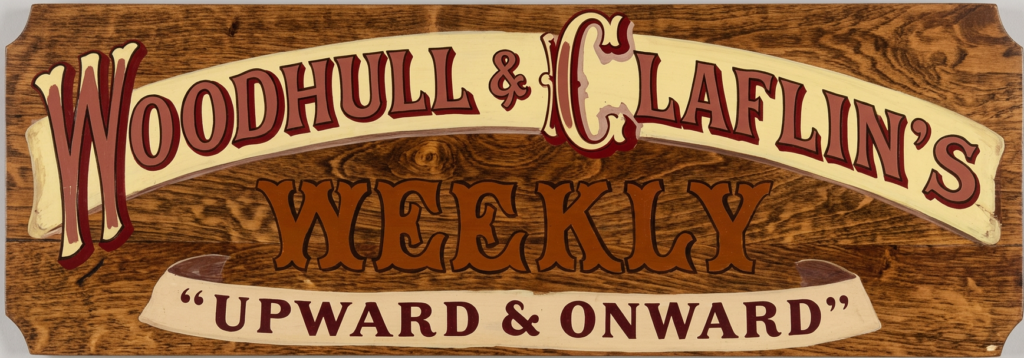
Webmaster’s note: The above is a complete transcript of “A LEGEND OF GOOD WOMEN” from Woodhull & Claflin’s Weekly. The article was written by Theodore Tilton and was mentioned in his final statement to the Investigating Committee of Plymouth Church in September 1874.
When this web site began in September 1999, there were no digitized copies of Woodhull & Claflin’s Weekly available online. Now you can find an almost complete run on the IAPSOP web site which has no affiliation with Victoria Woodhull & Company: