

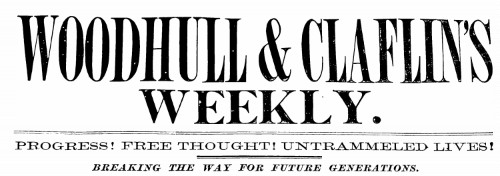
November 2, 1872
[Page 15]
GRANT OR GREELEY – WHICH?
In the absence of an electoral ticket of the Equal Rights Party [Victoria Woodhull’s party], we suppose that most men who would have voted for the candidates of that party, will vote for one or the other of the parties whom the men standing at the head of this article represent. If it were the man merely who is to be voted for, on account of his personal fitness, it seems to us that no person can be at a loss as to whom he should support. General Grant is, at heart, favorable to many of the reformatory movements; especially is he favorable to the cause of woman. He, as well as Mrs. Grant, believes that women ought to vote when they want to. Mr. Greeley believes that women are good cooks, and that cooks ought not to be voters. In a word, Mr. Greeley is utterly opposed to any reform in favor of women. This, so far as personality is concerned, should secure him the opposition of every woman who thinks she is as capable of self-government as man; and the support of every woman who thinks she was created to be ruled by men.
But it is not a fact that it is Grant or Greeley for whom votes are to be cast. It is for the parties which those men represent, and this puts an entirely different face upon the question as to which should receive the support of reformers. That ought to be determined without reference to the candidates, since, whichever will be elected, will be the slave of the party which elects him. General Grant acknowledged that he could not do what he wanted to do for woman, which was what was done for the Negro by his urging upon Congress the legislation in his behalf. Now, the question for women to decide in the support of these men is, which party is the more likely to do them justice.
Most of the leaders in the woman movement are advocating the election of Grant on account of the reference made to women in the platform of the Republican party. We differ from them as to the honesty of that reference. . . .The “respectful consideration” which is spoken of in that platform, it seems to us, could more fittingly have been bestowed when it was sought from Congress, which had the power to grant it, but did not. We believe that every hope women find in the fourteenth plank will prove a deceit. That plank could not possibly have been framed so as to seem to say more and really mean less. . . .
When we think of it, however, we cannot help repeating the Teacher of Nazareth’s parable of the Two Sons, recorded in St. Matthew XXI:28-31:
But what think ye! A certain man had two sons, and he went to the first and said: “Son, go work today in my vineyard.”
He answered and said: “I will not”; but afterward he repented and went.
And he came to the second and said likewise. And he answered and said: “I go,” and went not.
Whether of the twain did the will of his father. They said unto him, the first. Jesus saith unto them, ‘Verily, I say unto you, that the publicans and the harlots go into the Kingdom of God before you.”
Now, may it not be barely possible that this teaching of Jesus is applicable to the present situation The Liberal party which said it would not go work in the vineyard for woman may do it; while the Republican party which said it would work in the vineyard for women may not do so. At all events, we always prefer an outspoken opponent like the Liberal party, to a deceitful friend which we fear the Republican party is. Besides, this new party will find itself absolutely compelled to take up some new issue if it think to remain a party. It must have some point of cohesion which it has not got at present, and which it will not have unless it be successful, which does not now seem probably; therefore, we believe that the opposition party to the present administration, will be the one that will adopt woman suffrage.
But we do not urge the support of either of the candidates. We simply state our conviction, and if too much confidence be not placed in the “professed love” of the Republican party, its representatives may be riduculed into doing justice to the interpretations put upon the language of the Philadelphia platform.
There is another reason why we do not believe that Republicans endorse what the Philadelphia Convention said of the woman question as committing the party to suffrage. What party organ of any consequence has said that the Republican party is committed to the doctrines of woman suffrage, or has urged the election of its candidates because their success will insure the consideration and settlement of this question? It is true we find all the papers treating the women very courteously, and encouraging them to advocate General Grant’s election; but what one has said that the obstruction to woman suffrage must be cleared out of the way by Congress? On the contrary, like the party leaders, the papers have heretofore, almost universally, said that Congress has nothing to do with the citizen’s right to the ballot. We listened with great care at what the women said a few
nights ago at Cooper Institute in favor of General Grant, but neither one of them even hinted to these things which we consider the weak points in the professed adoption of the suffrage question by the Republican party.
Webmaster’s note: The election of 1872 had two major candidates—incumbent President Ulysses Grant (Republican Party) and Horace Greeley (Liberal Republican Party and Democratic Party). Victoria Woodhull was a third party candidate (Equal Rights Party). This article was part of the issue that led to the arrest of Victoria Woodhull, Col. Blood, and Tennie C. Claflin on a trumped of charge of sending “obscene” literature through the mail. Fortunately, Woodhull, Blood, and Claflin foresaw the government’s actions and secured some of their plates so they could reprint articles from this issue months later.
Download a PDF of the complete, suppressed scandal issue at IAPSOP.
When this web site began in September 1999, there were no digitized copies of Woodhull & Claflin’s Weekly available online. Now you can find an almost complete run on the IAPSOP web site which has no affiliation with Victoria Woodhull & Company: