

by Mary L. Shearer (2026)
“Exhaustively researched.” That’s what Penguin Random House called The Improbable Victoria Woodhull: Suffrage, Free Love, and the First Woman to Run for President, published in September 2025. If by that they mean historical researchers get exhausted trying to figure out what her sources are, then yes—they’re right! Instead of a traditional bibliography, she has “Primary Sources and Additional Readings” where she inexplicably commingled fact with fiction so closely they need to get a room! Under “Chapter Twelve,” which is about Woodhull’s second husband Colonel Blood, she listed Neal Katz’s novel, Outrageous. I take it that’s an “Additional Reading.” (It sure isn’t a primary source.) But why? Does she think “His moustache became my tickler” is a must-read? Or did she use the novel as a source for where five bullets hit Col. Blood’s body? Inquiring minds want to know.
Back in 1998 Barbara Goldsmith got “meticulously researched” for her acclaimed biography, Other Powers: The Age of Suffrage, Spiritualism, and the Scandalous Victoria Woodhull.” Goldsmith used nearly 600 sources compared to Collinsworth’s fewer than 200 sources. But Penguin Random House has assured us that Collinsworth has researched Woodhull so thoroughly that no one need ever research her again. What a relief! Now I can hit the beach.
Goldsmith spent a decade researching Woodhull and still did not have time to access most of her papers that are scattered across multiple states. By contrast, Collinsworth discovered Woodhull, researched her, wrote, and published a book within three years. That’s not enough time for a writer to organize their junk drawer, much less untangle the complicated record left behind by Woodhull. And the truncated timeline shows in the quality of Collinsworth’s book. What she produced was an elegant book report dressed up as a biography with no place to go.
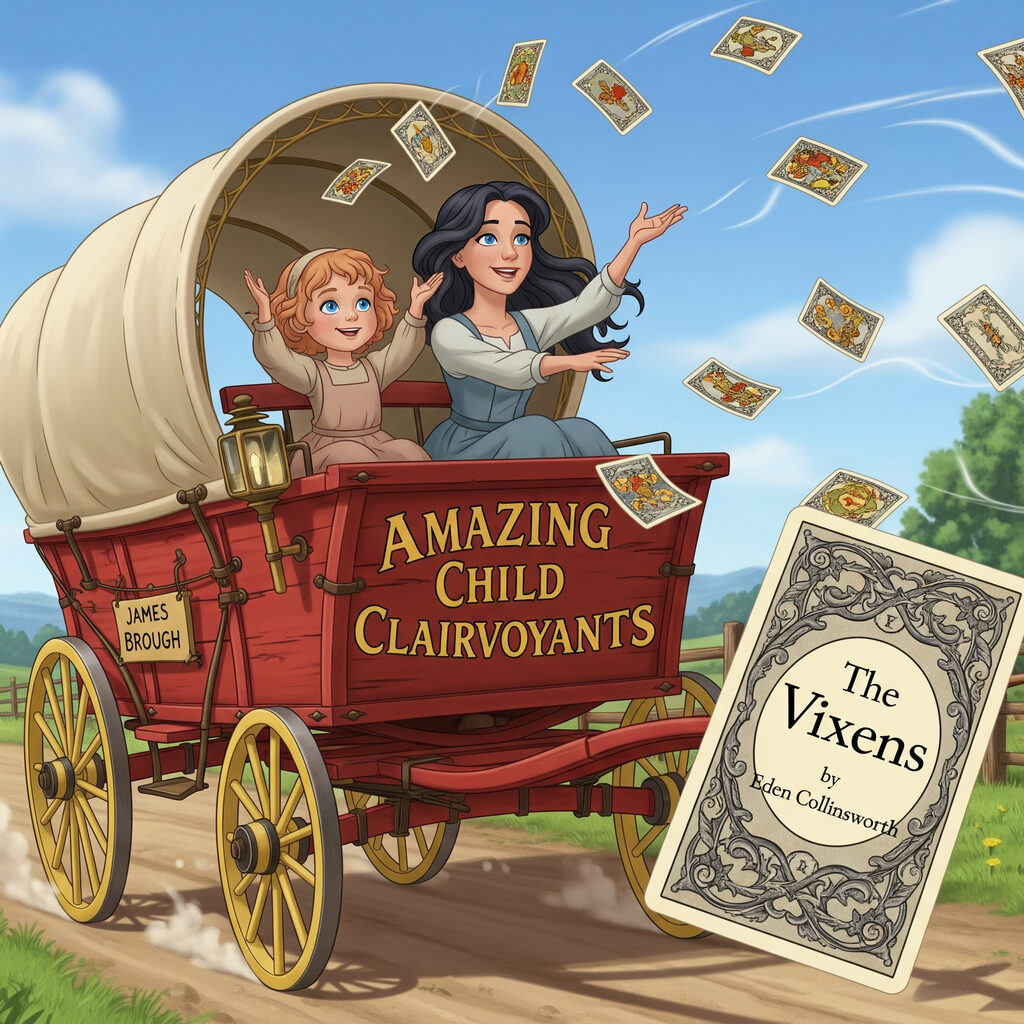
THE AMAZING CHILD CLAIRVOYANTS
Above is an AI depiction of how Collinsworth portrayed the childhood of Victoria Woodhull and her sister Tennessee Claflin. It’s wrong, but I suspect Collinsworth and her publisher don’t know its wrong. In her timeline, Victoria’s father Buck Claflin set fire to his mill in the dead of winter for $500 in insurance money. He fled in 1851 under threat of tar and feathering, and then put his daughters to work as child clairvoyants. (Tennessee would’ve been six and Victoria thirteen.)
But historical records don’t support her timeline. Just a couple years after the publication of the previous Woodhull biography, The Scarlet Sisters, records of the Homer fire were discovered that overturn the tale as told in every single biography. Courthouse records from 1846-1848 show the fire occurred June 13, 1846, earlier than any of the biographies suggested. The family was still living in Homer according to the 1850 U. S. census, and Buck sold his property in Homer in August 1852. Just looking at the timeline alone, the story that Buck fled after the fire is obviously wrong. He was there six years later! But Collinsworth didn’t contact any Woodhull scholars who could have pointed out new scholarship or old flaws they discovered in previous biographies. Collinsworth relied on secondary sources from the 20th century and not primary sources from the 1840s to 1860s to write about Woodhull’s early life.
Like all Woodhull biographers, she utilized The Terrible Siren, published in 1928. It claimed Buck charged his first fee for Tennessee’s clairvoyant powers after she predicted a fire in the cupola at Dickinson Seminary in Williamsport, Pennsylvania. But no year was provided which led a biographer in 1967 to speculate that Tennessee was six. It looks like that’s how Collinsworth came up with 1851. (1845+6=1851) But Tennessee was not six. The fire occurred in March 1858 when Tennessee was twelve, which completely changes the story:
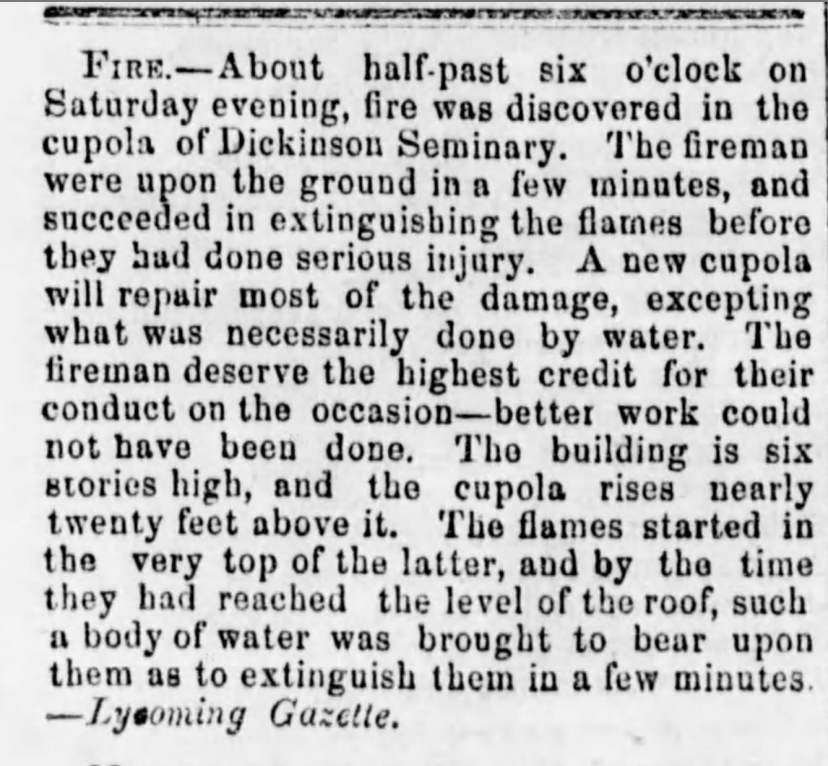
Victoria was 19 in March 1858 and living in Illinois when Buck put up that first sign in Pennsylvania. While Victoria claimed clairvoyant experiences practically since infancy, she never claimed to have worked as a child clairvoyant. This was made abundantly clear in Theodore Tilton’s 1871 biography of Victoria Woodhull where he wrote, “Hitherto her clairvoyant faculty had been put to no pecuniary use, but she was now directed by the spirits to repair to Indianapolis, there to announce herself as a medium, and to treat patients for the cure of disease.” Translated into modern English, Victoria did not make money off her psychic powers until she went to Indianapolis. Primary sources show Victoria was 21 at the time she lived in Indianapolis.
And Collinsworth is so confidently wrong about her timeline! During a book event broadcast on C-SPAN, Collinsworth stated with no hint of embarrassment that Victoria worked as a child clairvoyant AFTER the Civil War. Her timeline is chronologically challenged. The war ended in 1865 when Victoria was a 26-year-old mother of two. Victoria the child clairvoyant isn’t just The Improbable Victoria Woodhull, she’s The Impossible Victoria Woodhull.
On page 35, Collinsworth reprinted one of Tennessee’s ads from Columbus, Ohio, which said, “This young lady has been travelling since she was eleven years old….” But she performed a sleight-of-hand by not providing the year for the ad. It was from late 1859 when Tennessee, born in October, was said to be fourteen. If we take the ad at face value, Tennessee began traveling as a clairvoyant in 1856. (1859-14=1845. Born 1845+11=1856) At that time, Victoria, born in 1838, was 17 or 18 years old and a married mother of one. Collinsworth’s own source from 1859 disproves her assertion that Victoria was a child clairvoyant—because math!
NOVEL MISTAKEN FOR BIOGRAPHY
So why does she—and countless others—have this fantasy that Victoria Woodhull was a child clairvoyant in a traveling medicine show when the math proves it’s impossible? In the back of her book under “Primary Sources and Additional Readings,” she listed The Vixens: A Biography of Victoria and Tennessee Claflin. She incorrectly gave the year of publication as 1918 and not 1980. Despite the word “biography” in its title, it’s a novel. Yes, a novel.
Shockingly, Collinsworth is not the first writer, and will likely not be the last, to mistake The Vixens for a real biography. Barbara Goldsmith mistook it for a historical source. It’s in her bibliography, too. So much for meticulous. It has been misclassified in library catalogs ever since James Brough’s book came out in 1980. The novel relied on a tired rags to riches trope of a family fed on possum stew. Buck Claflin was portrayed as the proprietor of a seedy traveling medicine show who exploited his daughters Victoria and Tennessee and taught them how to fleece the rubes.
According to Collinsworth, Buck Claflin fastened a sign to his wagon that said “AMAZING CHILD CLAIRVOYANTS.” That phrase is from 1980, not 1851. Not only will you not find a 19th century ad for the “Amazing Child Clairvoyants,” you won’t find one for “Victoria Claflin” either because it was only Miss Tennessee Claflin who worked as a child clairvoyant.
Collinsworth even appears to have adhered closely to the novel’s dialogue which does not come from primary sources:
“Good citizens, we meet here tonight in a time of stress to bring comfort to troubled minds and ease for broken hearts,” was how Buck would greet the audience after they were seated and before ushering Victoria and Tennie onto the stage to join him. “I’m proud to say that these two girls, my daughters, will employ their unique facilities to enable you to communicate with those cherished members of your family who are wrongly referred to as ‘departed.'”
The Improbable Victoria Woodhull, page 34.
Compare that to The Vixens:
“Good neighbors one and all, we meet here tonight in these times of stress to bring comfort to troubled minds and ease for sorrowing hearts….Two gorgeous young ladies are thrilling and willing to serve you—daughters of mine, I’m proud to say. They will employ their unique faculties to enable you to speak with and possibly catch a glimpse of those cherished members of your families who you may have fallen into the sad habit of referring to as the departed.”
The Vixens, pages 72 to 73.
MYSTERIOUS TESTIMONY
Mistaking a novel for a biography is embarrassing, but at least that’s understandable. Barbara Goldsmith did it, too, and received high praise for it. What I don’t understand is where the following quotation comes from in her book:
“My father was a con man, who never passed up an opportunity that didn’t require him to work himself. He was a swindler, who used black paint to cover the flaws of the horses he sold. He was a cheat who, after losing at the card table, paid his debts with counterfeit money. Not only did my father force me to perform as a child clairvoyant, he would starve me for days at a time to enhance my performances.”
Having decided that disarming frankness would garner respect with the jury, Mrs. Woodhull welcomed their audible gasps.
The Improbable Victoria Woodhull, pages 17 to 18.
The quote above is supposed to be from Victoria Woodhull’s 1894 court testimony in the case John Biddulph Martin & Victoria Woodhull Martin v. The Trustees of the British Museum and Edward Maunde Thompson. I was stunned when I read it. It went against my decades of research, but if Victoria said it under oath, I’d have to admit I was wrong. So, I corresponded with an expert on the holdings of the British Museum Central Archive. She told me she reviewed Victoria’s entire two day testimony. There was nothing remotely like that in the testimony. Intrigued, I gained access to photographs of the complete case record in two bound volumes and found the same thing. Victoria never said any derogatory word about her father in that case. Where did Collinsworth get the quote?
CREATIVE LICENSE WITH DIALOGUE
The answer possibly may be found in the author’s note that appeared in the bound galley provided to advanced readers. It said the following:
The historical facts on which this book relies varied from source to source, and when no facts could be found, speculation led the way. None of the depicted characters are fictional, but I have taken creative license as it concerns dialogue and potential motivations.
My emphasis in bold
Doubleday, an imprint of Penguin Random House replaced that author’s note with the following:
In writing this account, I made use of a vast array of archival sources, which, as any writer grappling with the past understands, have their limitations, largely due to unjust implicit and explicit biases. Still, I have, when up against the limitations of the historical record, endeavored to accurately understand and re-create the motivations of the historical figures herein.
There’s nothing in the new note that mentions “creative license” taken with the dialogue, which does a disservice to Eden Collinsworth. She was up front that she had taken liberties with the dialogue. The publisher removed her warning to the readers, leading them to believe they are reading actual quotations from the court record when they are not. The new note says she recreated the motivations, but it doesn’t say she recreated dialogue.
If Collinsworth wishes to explain how she came about the testimony that is not in the court record, I’ll be happy to post her explanation. I won’t speculate as to why Collinsworth quoted Victoria telling a jury that her father starved her to enhance her clairvoyant performances when that claim originated with Barbara Goldsmith who did not provide a source citation for it. I won’t speculate why she claimed Victoria’s lawyer “laid out the miseries of her hand-to-mouth childhood, describing her indolent parents as ‘ignorant and violent’ people, and volunteering that she had been denied any real education and had often slept in the same clothes she wore during the day” when nothing similar to that is in the court testimony. But I will tell you what the court testimony actually does say about her parents. (Note: I have transcribed Victoria’s entire two days of testimony.)
The opening argument by Victoria’s lawyer included the following:
Gentlemen, Mrs Martin was born in the year 1838. She was the daughter of Reuben & Anne Claflin. They were her father’s & mother’s names. She was one of several children, & she had a sister whose name was Tennessee Celeste, as her christian name, – now Lady Cook. Of the earlier years of this lady’s life it is not necessary to say much, until we come to her marriage.
British Museum court transcript, Feb. 23, 1894, page 4.
She was married when she was not yet 15 years old. She was married at a little more than at the age of 14 years in the year 1853 to Dr Woodhull. She passed (& that I will mention afterwards) a great part of her public life under the name of Victoria Woodhull, & she is not infrequently called Victoria Woodhull, although her real name is Victoria Martin.
There is very little mention of Victoria’s parents in the transcript. On February 23, 1894, her lawyer mistakenly said her father died in 1888 when it was actually 1885. When her parents were mentioned it was to emphasize that they had been libeled like their daughter. Her lawyer talked about a book called The Beecher-Tilton Scandal, published in 1874 by F. A. Bancker:
This is an account and a most slanderous and libelous account of the family of Mrs Martin, of her Father, and of her Mother, written in the coarsest style. I will read from page 125 respecting the family of Mrs Martin. “Consequently at every Town along the River where Boatmen most congregate, there were gamblers, horse-traders, and bloodsuckers of every description ready to pounce upon the Boatmen and drain them of their last cent. Buck McLaughlin was one of the most successful of these Adventurers.
British Museum court transcript, Feb. 26, 1894, pages 184 to 185.
He had a high toned sort of way about him that won the poor devils’ confidence and their money at the same time. There was no man in the whole gang of gamblers at Harrisburg or along the River that could flip up a “Jack” in a game of “Old Sledge” more deftly & artistically than Buck McLaughlin.” He was Mrs Martin’s Father. The Honble John took a great fancy to Buck McLaughlin[.]
They became fast friends. The Honble John had a large farm known as Mahoney in what was then Chapman’s Township, Union County, Pennsylvania, now Union Township, Snyder County, two miles below the Borough of Selinsgrove”
That is the worst of what was said about Victoria’s parents in the court record, and it originated in the Brooklyn Eagle, July 24, 1874, page 4. Its libels are nothing compared to the words Collinsworth put in Victoria’s mouth that she never said.
INATTENTION TO DETAIL
Believe it or not, Collinsworth’s alleged quotations from the court record aren’t the only problem with her account of the trial. She wrote that the trial took place in the Queen’s Bench Division of the “Old Bailey.” As you can see in the picture below the case was filed “In the High Court of Justice Queen’s Bench Division.” That’s a completely different building. The reader is supposed to trust her account of the trial when she can’t even get the venue right?
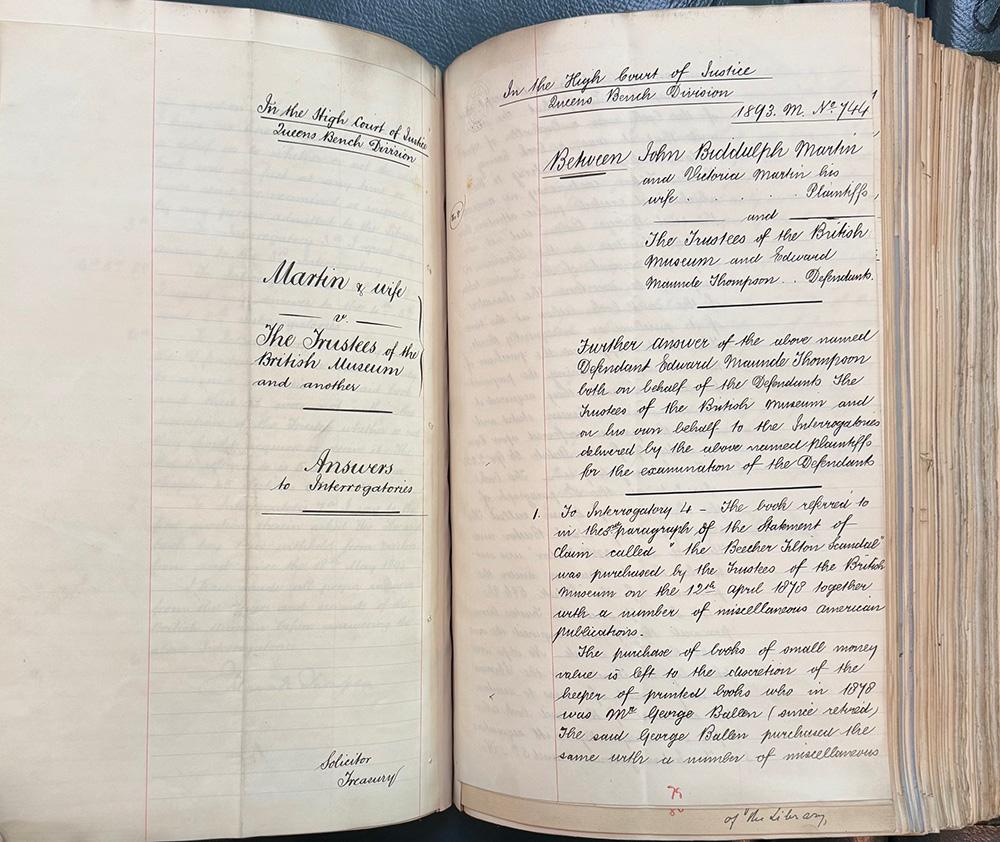
Collinsworth displays a distinct indifference to exactitude. In an interview with Kenny Ryan Austin, she described how she learned about Victoria Woodhull in the British Museum:
There were no books on the shelf, but there were these beautifully kind of vellum, you know, egg blue color vellum, you know, folios. And on the on the spine was Woodhill versus the British Museum.
https://podcasts.apple.com/us/podcast/the-improbable-victoria-woodhull-an-interview/id1505267377?i=1000724349746
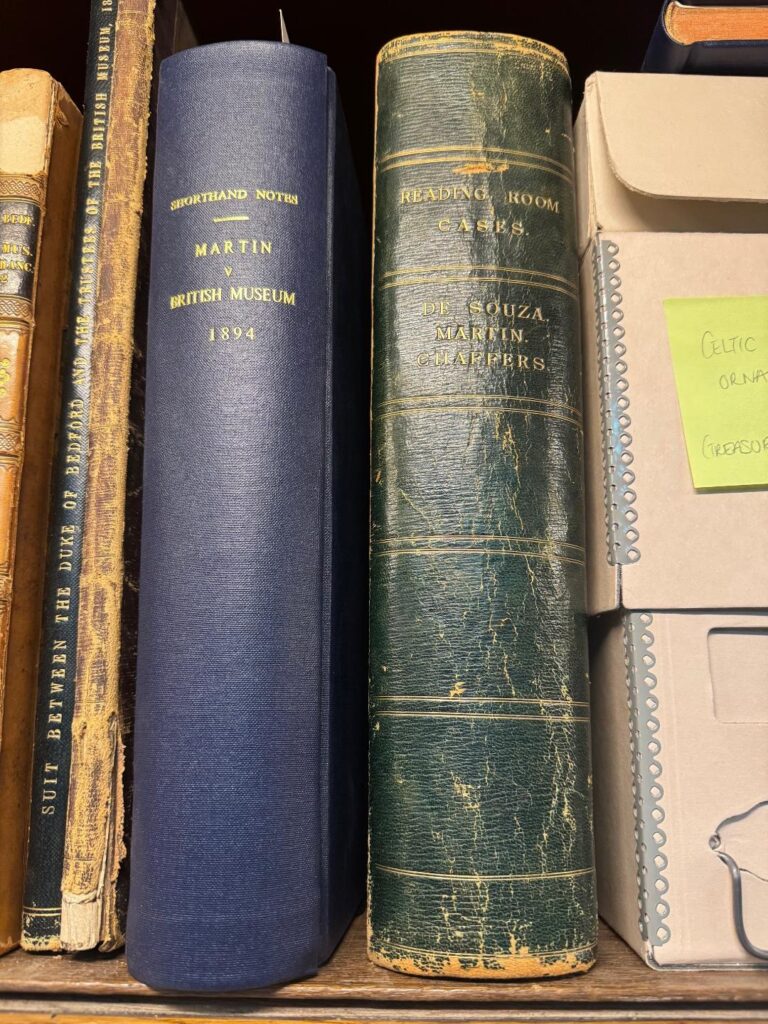
Below is a picture of the two bound volumes that contain the records of the trial at the British Museum Central Archives. Do they say “Woodhull”—or as she said “Woodhill?” Do they look robins’ egg blue?
SIMILARITIES TO MRS. SATAN
There are numerous concerns I have about this book that I can’t even begin to cover. For example, she said Buck Claflin volunteered to be Postmaster. That’s an appointed position, either by the Postmaster General or the President of the United States. You can’t volunteer. But that’s all minor compared to what she wrote in Part VI. “Victoria Woodhull makes her thoughts known in written journals.” I take that to mean those lines are supposed to be from Victoria’s own handwritten journals. She does not say where she got these journals, but look at this particular passage:
I was divorced from Canning Woodhull for reasons that to me were sufficient. But I was never his enemy. When he appeared, sick and shivering, at the door of my home in Murray Hill in New York City one day, he was by then addicted to morphine as well as alcohol. He had no one to turn to but me, his onetime wife. Considering that my prominence as a broker on Wall Street already had caused controversy, I might well have denied him sanctuary. But that would have been hypocrisy, which I scorn.
The Improbable Victoria Woodhull, p. 215
The above is supposed to be Victoria Woodhull’s own words. Here’s a passage written by biographer Johanna Johnston in 1967:
About this time, a sick and shivering figure appeared at the door one day. It was Canning Woodhull. Addicted to morphine as well as alcohol by now, he had no one to turn to in his desperation, it seemed, but his onetime wife, Victoria. Victoria might well have hesitated to offer him sanctuary, considering her current prominence and the talk already circulating about her and her family. But that would have been hypocrisy, which she scorned. She took Canning Woodhull in.
Mrs. Satan, p. 61
I know what some people might say. Maybe Johanna Johnston saw the same journal as Collinsworth. Johnston took Victoria’s words and turned them into third person, rather than Collinsworth took Johnston’s third person words and turned them into first person. But there’s one very good reason why that’s not possible. Johnston was mistaken when she said Canning turned up at Murray Hill after February 1870, asking for sanctuary. He was already living with the family at her previous address, 17 Great Jones St., in 1868 and 1869. Victoria would know that; Collinsworth would not, unless she were an exhaustive researcher.
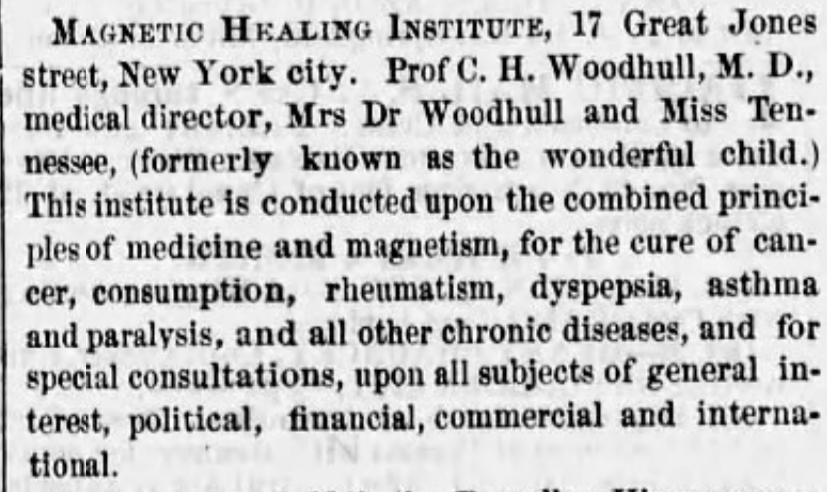
Despite this books flaws, I originally thought it would be salvageable in a reprint. Get rid of the material that came from the novel The Vixens and remove the fake quotes about Victoria’s father, and create a real bibliography that doesn’t mingle primary sources with additional readings…until I realized the structure of the book is fundamentally flawed.
Collinsworth used Richard Garnett as a literary device. Some people were irritated by it, but I thought it was clever. I liked what she did. Then, I learned Richard Garnett was not a defendant in the lawsuit as she claimed. He was a witness. In interviews she refers to Garnett as the “head librarian” but the Principal Librarian was Edward Maunde Thompson who was not mentioned in the book. Thompson along with the Trustees were the real defendants. Sir Charles Russell was quoted in the transcript as follows:
The 3 principal Trustees are the Archbishop of Canterbury, the Lord Chancellor, & the Speaker of the House of Commons. Some of the others are the Lord President of the Council, the First Lord of the Treasury, the Lord Privy Seal, the First Lord of the Admiralty, the Lord Steward, the Lord Chamberlain, the Principal Secretaries of State, the Lord Bishop of London, the Chancellor of the Exchequer Lord Coleridge, Lord Esher the Master of the Rolls, the humble individual who addresses you, Sir John Rigby, Professor George Gabriel Stokes, Sir William Jenner, Dr. John Evans & Sir Fred[eric]k Leighton. Those are the principal Trustees. Then there are certain additional Trustees, some appointed by the Sovereign consisting of Royal Dukes & other distinguished persons & certain supplementary Trustees known as family Trustees. That is the body….”
Martin v. Trustees transcript, Feb. 24, 1894, p. 78-79
CONCLUSION
So, you have a book framed around a defendant who wasn’t a defendant at a courtroom where the trial never took place with testimony that was never said. And because the biographer had a difficult time distinguishing fiction from history, she painted a false picture of a woman born into degraded poverty, working as a child clairvoyant, and descended from Jewish Indians. (Could Victoria Woodhull really be Mel Brooks in Blazing Saddles?)
Calling this book “exhaustively researched” is pure marketing hype. Collinsworth overlooked substantial Woodhull archives in Illinois, Kentucky, and Ohio. She limited herself to archives in London, New York, Boston, and Washington, D. C., failing to get a complete picture of her subject. It’s a shame, because many people consider her a good writer, but when it comes to history, as she herself once claimed, speculation led the way. She took herself and her readers in the wrong direction.
TO PURCHASE
If you can’t beat ’em, join ’em. If you’re going to buy The Improbable Victoria Woodhull anyway, please consider purchasing it through my links. As an Amazon Associate, I earn commissions from qualifying purchases.