

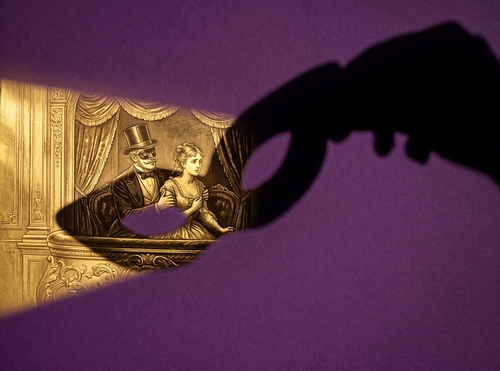
Decades before millionaire Bruce Wayne donned a mask to protect the citizens of Gotham City, New York’s millionaires discovered they could use the anonymity of the domino mask to prey on women during the city’s fancy dress masquerade balls.
In the November 2, 1872 issue of Woodhull & Claflin’s Weekly, Victoria Woodhull and her sister Tennessee “Tennie C.” Claflin exposed one of those wealthy men, Luther C. Challis, who sexually assaulted two girls from Baltimore whom he met at “the French Ball.” Consequently, the women were arrested for libeling Challis but refused to retract their story. They were eventually acquitted of the libel in March 1874.
Woodhull biographer Barbara Goldsmith shared an image in Other Powers purporting to be “the French Ball” made notorious by Woodhull and Claflin. She not only misidentified the year of the image, she conflated two different French organizations. She claimed the French Ball attended by Luther Challis and the Claflin sisters occurred in 1869 under the auspices of the Société des Bals d’Artistes, but the image she shared was from a completely different ball in 1880!
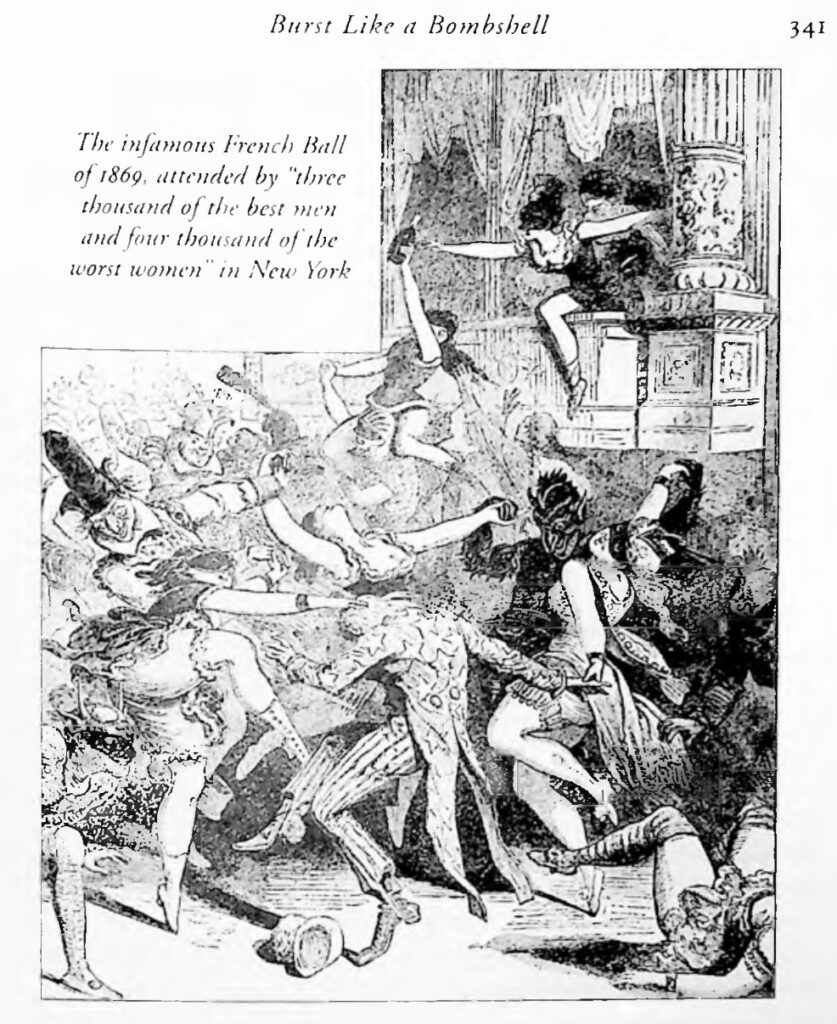
Above: Barbara Goldsmith, Other Powers: The Age of Suffrage, Spiritualism, and the Scandalous Victoria Woodhull (New York: Alfred A. Knopf, 1998), p. 341.
Miscaptioned “The infamous French Ball of 1869….”
At right (or below): The National Police Gazette, Jan. 24, 1880, p. 9. Source: Edward Van Every, Sins of New York: As “Exposed” by the Police Gazette (New York: Frederick A. Stokes Company, 1930), p. 197.
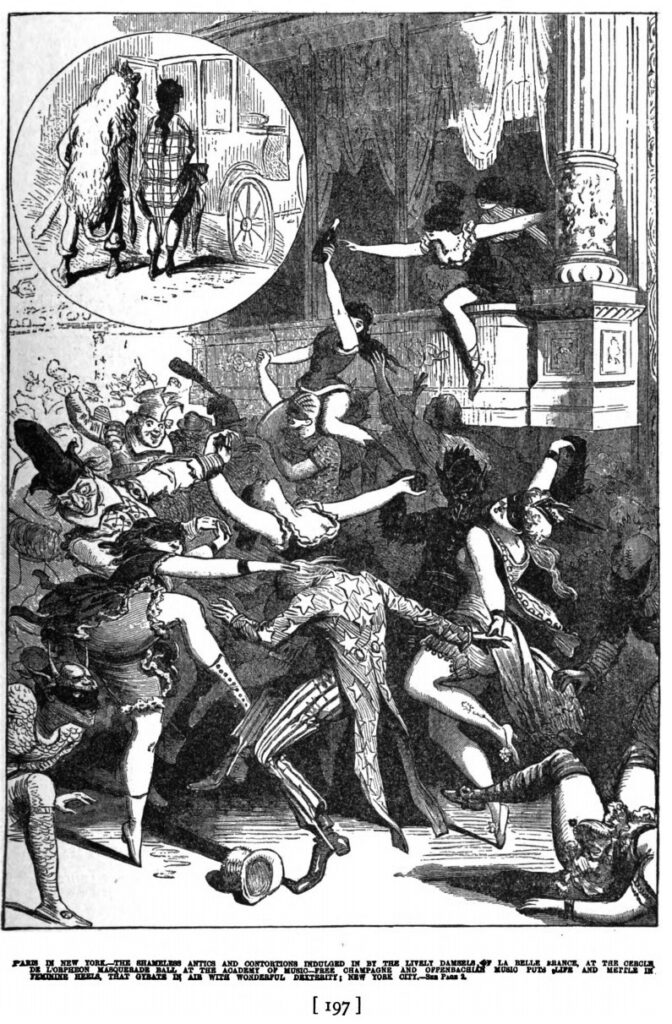
Below is a close-up of the caption from the January 24, 1880, National Police Gazette image that is identical to the one published in Goldsmith’s Other Powers. Her endnotes said the image came from “James McCabe’s Light and Shadows of New York Life,” page 354 which is demonstrably false. (Goldsmith also dropped the “s” from the actual title, Lights and Shadows of New York Life.) The organization that arranged the ball depicted was “THE CERCLE DE L’ORPHEON” which also appeared in the New York Times as “The Cercle Musical de l’Orpheon Français.” That organization did not hold a ball in 1869 or 1872.

Goldsmith cultivated the impression that the “French Ball” was one notorious annual event when it was actually a term for a category of balls held regularly in New York City during masquerade season from approximately December to April. French Balls could be balls organized by French persons or societies like the Bals d’Artistes or the Cercle Français de l’Harmonie. They could also be risqué balls organized by Americans like Charley Edgar for the purpose of fun or debauchery, depending on your point of view. They were called “French” because it was a catch-all term for all things naughty. A New York “gentleman” might take a French Safe for his French Balls taking a French Kiss and then his French Leave for a scandalous night out. Without the context of the event, it’s impossible to tell which of the two types of French Balls someone was attending. And sometimes they attended a French Ball that was both French and “French” at the same time!
So, what type of French Ball did Victoria and Tennie attend? It wasn’t clear from the newspapers at the time. The sponsors of the French Ball were never mentioned. Subsequent newspaper accounts provided little clarification beyond the acknowledgment that the ball occurred “last winter” at the “Academy of Music” about five weeks before Feb. 22, 1872. The ball that best matches the description is “The French Ball” organized by the Cercle Français de l’Harmonie that took place on Monday, January 15, 1872.
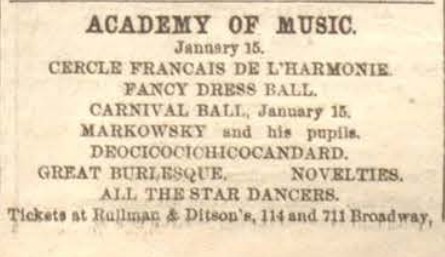
Before the Cercle’s French Ball, the New York World emphasized that it was not the indecent type of French Ball. It was legitimately French:
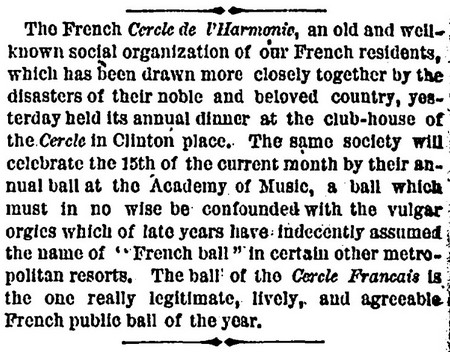
It may be because this French Ball was one of the “respectable” balls that the Claflin sisters were determined to expose what went on behind the scenes in January that year. According to the sporting man’s newspaper, the Days’ Doings, “the present Masquerade Season has been a comparative failure. It is true, decent people in New York have became disgusted with so-called ‘fancy dress and masquerade balls,’ but there has been a special reason for this discouraging fact—and this special reason can be found in the excesses to which New Yorkers have in previous years allowed these masquerades to be carried. New Yorkers do nothing—either good or bad—by halves, and so, having received the idea of masquerade balls with favor, they at once proceeded to bring them into disfavor at once, by out-Heroding Herod, exaggerating all the worst features of the masquerades, and utterly ignoring all their more delicate and delicious elements.” (March 16, 1872, p. 2)
The New York Times, on the other hand, said “The ball was in every way a success, despite the large attendance. Owing to the excellent management of the President, of Mr. CHARLES VILLA, and of several other gentlemen, not the slightest untoward incident occurred to interrupt the pleasures of the affair.”
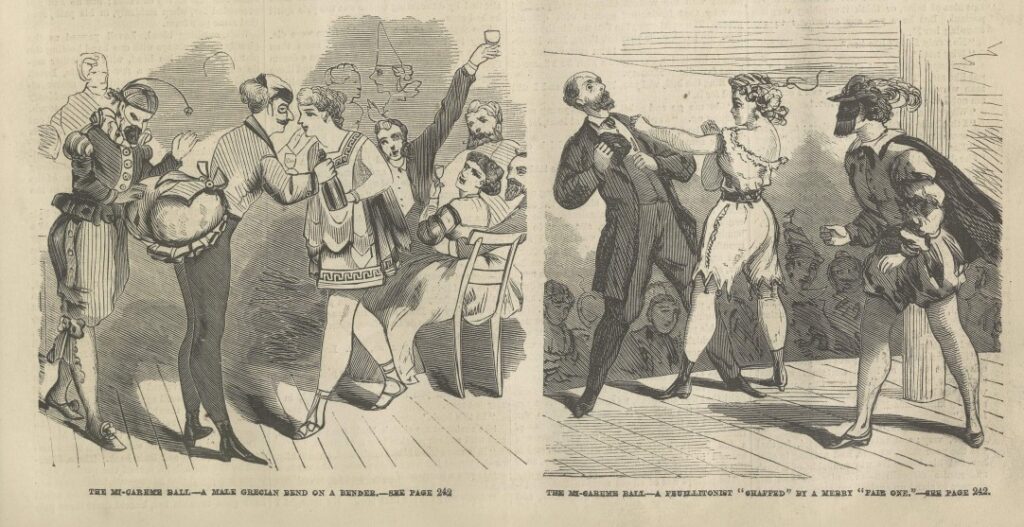
While there are no lithographs or photographs, as far as I can tell, of the 1872 French Ball organized by the Cercle Français de l’Harmonie, there are lithographs of their 1869 ball which appeared in the Days’ Doings. While the costumes are not indecent by today’s standards, the exposure of female legs was considered shocking for the era. There were men dressed as women and women dressed as men, pushing the boundaries of what was allowed, while women in full evening dress gawked at the scene from the private boxes above.


While Goldsmith misidentified the French Ball, she was at least correct that the Société des Bals d’Artistes organized a ball in 1869. It was mid-lent and called the Mi-Careme Ball. There are lithographs in the Days’ Doings of that event as well as seen below:
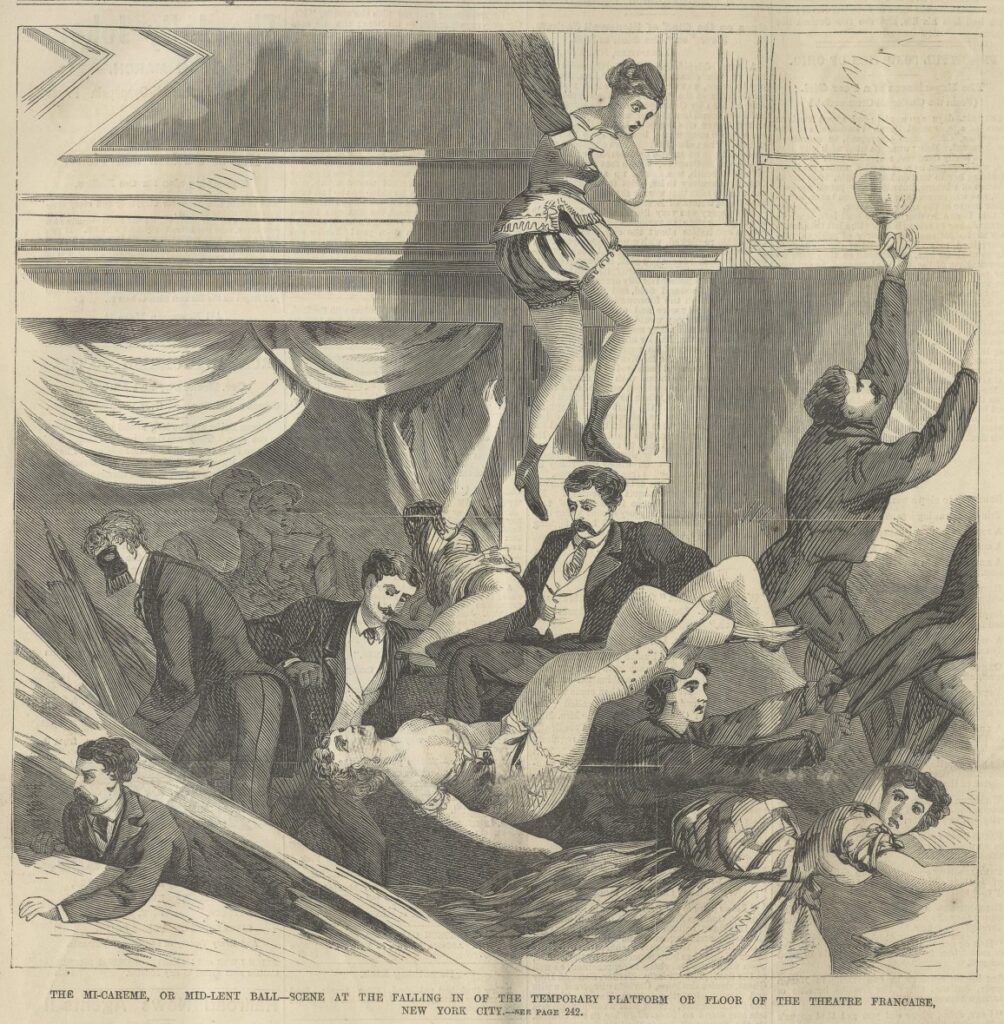
During the Mi-Careme ball on March 4, 1869, there was a major mishap. The New York Tribune reported that “a large portion of the platform in the center of the ball-room gave way, crushing the parquette seats, but fortunately injuring no one.” Naturally, the Days’ Doings turned the accident into a spectacle of well-turned legs.
The lesson to be learned from Goldsmith is this: Any time you encounter a mention of a French Ball in 19th-century New York City lore, you must stop to ask who organized the ball, what was its purpose, and was it crashed by any randy “rowdies.” The French Ball could be anything from a society event to a bacchanalia—or both. While the New York Times in 1882 claimed the ball organized annually by the Cercle Français de l’Harmonie was “supposed to be the naughtiest of the ‘respectable’ masked balls,” it was not the only French Ball in town.