

by Mary L. Shearer
On June 13, 2026—the 180th anniversary of the Homer, Ohio fire—Kate Danaher, former English literature professor at Rosemont College, launched her new novel, Unstoppable: The Victoria Woodhull Story at the Robbins Hunter Museum in Granville, Ohio. The book is the culmination of roughly 17 years of research. In 2016, Kate realized she had been led completely astray by Barbara Goldsmith’s celebrated 1998 biography, Other Powers. When Kate discovered that Goldsmith’s Methodist Revival conception story did not come from Victoria Woodhull’s “own account,” she returned to primary sources to find the real Victoria behind the sensational headlines.
Because I shared a significant amount of my own primary source research with Kate, I can’t be objective enough to review her book, so I won’t. But I will tell you this: Kate wrote her novel utilizing multiple sources contemporaneous to the 19th century. While almost every novel written about Victoria since 1998 resurrects Other Powers, Kate’s does not.
Unstoppable available at the following fine retailers:
(Note: As an Amazon affiliate, I make commissions on qualified purchases.)
KATE DANAHER’S SEARCH FOR BARBARA GOLDSMITH’S UNTRACEABLE SOURCES
Other Powers was well-written and highly acclaimed. What little criticism it received came from academics like Ann Braude and Helen Lefkowitz Horowitz. On the surface, the book looks impressively well-sourced—until you actually try to utilize Goldsmith’s endnotes and bibliography.
Hoping to find answers to Goldsmith’s many unique, unsourced claims, Kate went directly to the New York Public Library to examine the Barbara Goldsmith Papers. Instead of finding sources, she found numerous citations that simply said “TK.” That’s journalistic shorthand for “to come.” Goldsmith indicated that she would produce her sources later, but in many cases, she never did. Many of her claims are simply untraceable.
Furthermore, Kate noticed that early drafts read more like fiction than biography. There were multiple anachronisms, including a jaw-dropping chronological impossibility involving Jim Fisk who was murdered in 1872 assaulting Evelyn Nesbit who was born in 1884. For Goldsmith’s story to be true, Fisk had to attack Nesbit from beyond the grave like a poltergeist!
TRIGGER WARNING
Because of the sensitivity of the topic I am providing a link to a separate page containing Goldsmith’s salacious allegations for mature audiences only. The page is not recommended for children. It demonstrates the extent of her fabrications and its real world consequences.
THE ROSETTA STONE FOR UNDERSTANDING GOLDSMITH: BOX 88 FOLDER 14 PAGES C1-C4
Kate and I believe we found an explanation for Goldsmith’s fabrications, some of which ended up in the published book. It’s because of Goldsmith’s unorthodox methodology described in Box 88 Folder 14, pages C1 – C4, of the Barbara Goldsmith Papers (MssCol 18068) at the New York Public Library. Kate requested permission to publish these four unpublished pages, but the Goldsmith estate denied the request.
Because of copyright restrictions, I can’t quote the material here. However, I will say this: if you are a historian intending to cite any unique, unsourced claim from Goldsmith’s book—like the Claflins did not have an outhouse—do not do so until you read the unpublished introduction for yourself. It is the “Rosetta Stone” for understanding why Other Powers is deeply researched in some areas and pure fiction in others. As far as I can tell, the method she used has never been used by any serious biographer — and, judging by the results, should never be used by another biographer ever again.
THE BIG BUCK BLOW-UP: Buck Claflin Cleared of Arson
The same day as Kate’s book launch, I gave a presentation I called the “Big Buck Blow-up.” I used court records from 1846 to blow up the story that Buck Claflin was an arsonist in Homer, Ohio. I traced this fake arson and vigilante story back to its origins: neighborhood gossip from Homer resident Belle Selby Fulton which was weaponized by a blackmailer at the Chicago Mail in 1892.
Everywhere you turn on the internet, Buck Claflin is practically convicted of arson. The stories are inconsistent about the year it happened, the amount he collected if any, and whether it was a grist mill or a saw mill. But they all insist that Buck was driven out of Homer under suspicion of arson when he was threatened with tar and feathering. The climax has one of two endings: either the entire family “vanished in the night” or the Presbyterian Church took up a collection to send the Claflins out of town.
In a book published in September 2025 by Doubleday, an imprint of Penguin Random House, Eden Collinsworth wrote:
Various get-rich schemes resulted in enough ill-gotten money for him to purchase a gristmill in town that he never actually ran but insured for $500. When it burned to the ground in the dead of winter, suspicion among the townspeople was that he set fire to it for the insurance payment.
The Improbable Victoria Woodhull, p. 30
WHAT THE 1846 COURT RECORDS PROVE
The primary sources from Portage and Knox counties I found completely obliterate not only Collinsworth’s version of the story, but every version as it’s been told since The Terrible Siren was published in 1928.
The Real Date: The fire did not happen in the “dead of winter,” when Victoria was eleven or fourteen. It occurred on Saturday, June 13, 1846 when she was seven.
The Real Value: Buck didn’t own a random, rotting mill he “never ran.” He owned a fully operational gristmill and a sawmill. They were valued at a combined $6,450 to $6,500 (roughly $285,000 in today’s purchasing power). To discourage fraud, the insurance company capped his policy at two-thirds value: $4,300.
The Cause: They never determined the cause of the fire, but it originated in a joiner’s shop that Buck added to the gristmill in March 1846. The insurance company didn’t claim the mill was abandoned; they actually fought the claim because Buck had made active “alterations and additions and a change of occupants” right up to the day of the fire.
The Payout Irony: Had the insurance company paid within the standard three-month window, the payment would have landed on September 23, 1846—Victoria Woodhull’s eighth birthday. Instead, they fought it. Buck’s mortgage lender hired attorneys and sued the insurance company. After accusing Buck of negligence, the insurance company suggested arson but apparently the jury didn’t buy it. The Portage County jury awarded a $4,819.76 judgment in October 1848.
Follow the Money: Get this—The entire court-ordered judgment went directly to his mortgage lender, Henry B. Curtis of Mt. Vernon, Ohio. Buck sunk deeper and deeper in debt until he sued Curtis and won a $1,114.28 judgment in Knox County in May 1853.
The Real Exit from Homer: The Claflin family was still living in Homer in 1850 according to the U. S. Census. He sold his property in Homer in August 1852 so he didn’t flee the town forever in the immediate aftermath of the fire.
You don’t have to take my word for any of this. I have uploaded my photographs of the original court records, transcripts and summaries from Portage, Knox, and Licking counties to a public Google Drive.
https://dub.sh/XymR5Ni
All I ask is that if you share these records, you attribute the discovery to Mary L. Shearer, a descendant of Col. James H. Blood’s third wife.


A CENTURY-LONG BATTLE WITH PUBLISHERS
I originally intended to withhold these documents until the publication of my own biography to help attract and secure a prestige publisher. However, Penguin Random House has forced my hand by continuing to print falsehoods about Victoria Woodhull, Buck Claflin, and my own great-great-grandmother Isabell Blood. Some of the false allegations Collinsworth has made about Buck in interviews are sickening.
For my family, this has been a nearly century long battle with publishers. The first member of my family to fight this battle was my Great-Great-Uncle Irving S. Fogg back in 1927, when he challenged the intended depiction of his sister with Harper & Brothers (now HarperCollins). He won that battle, but not the war. It shouldn’t take a century to correct the public record, but here we are.
And the clock keeps on ticking! Sadly, I can’t even correct the record on Wikipedia, which currently features this falsehood:
By age 11…She was forced to leave school and home with her family when her father, after having insured it heavily”,[5] burned the family’s rotting gristmill. When he tried to get compensated by insurance, his arson and fraud were discovered; he was run off by a group of town vigilantes.[5]
Wikipedia
Because my 1846-1853 court records are unpublished, Wikipedia editors will likely reject them as “original research,” even though Wikipedia policy allows primary sources for verifying straightforward factual claims. According to Wikipedia custom, a 1956 article by Gerald W. Johnson in American Heritage is considered a “reliable, published source,” while the unpublished legal records are often viewed with more caution despite being more accurate.
Yet Johnson’s “reliable” article couldn’t even get Victoria’s mother’s name right, calling her Roxy instead of Anna. There are no records where she is recorded as “Roxy.” That name originated in a libelous Brooklyn Eagle article published on July 25, 1874. In 1928 the author of The Terrible Siren inaccurately called Victoria’s mother Roxy, and authors have been repeating it ever since. Here is the name of Victoria’s mother as it appears in an 1843 deed:
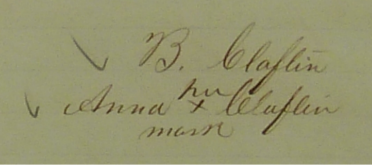
One of these days, I hope a journalist will pick up this story and publish a feature on how Buck Claflin has been falsely accused of arson since 1892 —and falsely accused of starving his daughters since 1998.
How long must people wait for the truth to come out? Apparently a hundred years — until a journalist finally decides to tell the real story. The documents are here. The evidence is clear. All that’s missing is the courage to report how the major publishing houses have fabricated the history of Victoria Woodhull and her family from 1928 to 2025 while accusing Victoria of fabricating her own history. The irony is palpable.