

A Century of Victoria Woodhull Biographies (1928-2026)
by Mary L. Shearer
The first full-length, modern style biography about Victoria Woodhull was published in 1928. The Terrible Siren was written by Emanie Sachs, a novelist, who said she included “the false and the true…because both show what people thought and felt about Victoria Woodhull….” She compared Victoria to the fictitious Paul Bunyan and said, “she and her remarkable family were only half real.” Despite this warning, generations of writers have repeated her folklore and internalized her portrayal of an unscrupulous, scarlet woman who made up stories, driven by a love of publicity.
The next “biography” came out in 1947. It was Whirlwind in Petticoats by Beril Becker. The cover clearly said it was “fictionalized biography” but that didn’t stop journalists Gerald W. Johnson and Irving Wallace from utilizing the novel as a historical source. Johnson published an article “Dynamic Victoria” in America Heritage Magazine in 1956 which laundered the fictional origins of his tale, and the following year he devoted a chapter to Victoria in his book, The Lunatic Fringe. That same year, Irving Wallace published a chapter about Victoria in Square Pegs, republished in 1972 as The Nympho and Other Maniacs.
Both Johnson and Wallace relied on The Terrible Siren and Whirlwind in Petticoats. By the time Whirlwind in Petticoats was reprinted as The Spitfires in 1953 and 1964, the cover dropped the label “fictionalized biography.” Instead, it was accurately labeled “a novel” but it was too late. The damage had been done. Kirkus Reviews had praised Whirlwind in Petticoats as “A colorful biography of an equally colorful personality, for a woman’s audience.”
The year 1967 was a banner year for Woodhull biographies. Two came out— Mrs. Satan by Johanna Johnston and Vicky by M. M. Marberry. Mrs. Satan relied heavily on The Terrible Siren. She cited both Johnson and Wallace as well as an additional novel, Robert H. Fuller’s Jubilee Jim Fisk. Marberry also cited Wallace whose work was contaminated by fiction.
In 1976, a biography for young adults was published called, Free Woman by Marion Meade. Arguably, this was the first biography to treat Victoria with respect, rather than as a scandalous train wreck. However, the book contained copious amounts of invented dialogue, including a scene where the elegant Woodhull women of Rochester make fun of the country bumpkin Victoria who lashes out at her mother-in-law calling her an “The old cat!” In reality, Victoria’s mother-in-law Louisa Stedman Woodhull was from the village of Webster, New York, where it was a common sight to see cows driven through the four corners of town. This book was republished in 2000, but still does not contain a warning that it contains reconstructed scenes and invented dialogue.
In 1980, Kirkus Reviews slammed The Vixens: A Biography of Victoria and Tennessee Claflin. They accurately described it as “not a biography but a kind of slangy screenplay, based on history but padded with reams of imaginary dialogue that ranges from vulgar to excruciating.” Unfortunately, librarians catalogued this novel as a “biography” because it contained that word in the title. The book vividly described Buck Claflin teaching his daughters to fleece the rubes in a traveling medicine show.
Victoria Woodhull was rediscovered again in the 1990s. Three biographies were published that expanded Woodhull scholarship and are still widely regarded as important today. The first was The Woman Who Ran for President by Lois Beachy Underhill published in 1995. Underhill continued the respectful approach of Meade, but she also used flawed sources like Sachs and Johnson. She took quotes from Theodore Tilton’s short 1871 biography of Victoria Woodhull and attributed them to Victoria and not to Tilton.
In 1998, Notorious Victoria by Mary Gabriel and Other Powers by Barbara Goldsmith were published. To her credit, Gabriel was the first biographer since Emanie Sachs to visit Victoria’s birthplace of Homer, Ohio, but she — like all the biographers before and since — missed courthouse records in Knox, Licking, Morrow, and Portage counties and relied instead on Sachs and Tilton for Victoria’s early life which mars her otherwise ground-breaking work. Like many of the other biographers, she also used Johnson whose work was tainted by Beril Becker’s novel.
The most remarkable out of all these biographies is Other Powers which displaced The Terrible Siren as the “definitive Victoria Woodhull biography.” Goldsmith told the public that her book was written with meticulous sourcing of letters, diaries, and private papers. But a recently discovered unpublished introduction suggests her first draft was written through spirit channeling. She contacted Victoria’s spirit as she was writing. Then, she would do research later to see if she could find sources to support what she had already written. If she didn’t find anything, she labeled her sources “TK” which is journalistic speak for “to come.” In many cases, these sources never materialized.
But that wasn’t the only problem with sources in Goldsmith’s book. Like Johnston, she used the novel Jubilee Jim Fisk as a historical source. She also used the novel The Vixens as a source for the Claflin’s so-called traveling medicine show. Furthermore, she used an 1892 Chicago Mail newspaper article published by a blackmailer who was sued for libel to prove Victoria and Tennessee were madams in the 1860s. One of the alleged brothels, according to Goldsmith, was in Chicago at 265 Wabash where she said Victoria moved in January 1864. The 1864 and 1865 city directories show 265 Wabash was the Sisters of Mercy Hospital where the Sisters (not the sisters) also ran an orphan asylum. The book looks well-sourced but much of the Claflin story is fiction. The book rides on the fumes of Goldsmith’s stellar reputation which is undeserved.
In 2000, American Lady of the Manor was published in England by Owen Stinchcombe. This is one of the most difficult books to obtain, but it filled out missing scholarship on Victoria’s later years abroad. Some of his work was utilized two years earlier by Mary Gabriel. Even in England Stinchcombe was influenced by the negativity of previous American biographers who doubted Victoria’s veracity. He suspected Victoria falsely claimed credit for convincing Jerome K. Jerome to take his 1907 short story, “The Passing of the Third Floor Back,” and turn it into a play in 1908. Stinchcombe wrote, “there is no evidence that they ever met.” But there is evidence. Victoria saved letters from the Jeromes that are located at Southern Illinois University. On Aug. 1, 1905, his daughter Rowena thanked Victoria for boxes of sweets and hoped her father would buy her a motor car like the one he recently rode in. On May 11, 1911, Jerome K. Jerome thanked Victoria for encouraging him to turn “The Passing of the Third Floor Back” into a play.
At the beginning of the 21st century, two biographies for younger readers as well as a picture book were published. In 2000 Victoria Woodhull: First Woman Presidential Candidate by Jacqueline McLean was published as part of the Notable Americans series. In 2002 Victoria Woodhull: Free Spirit for Women’s Rights by Miriam Brody was published as part of Oxford Portraits. And in 2004, A Woman for President: The Story of Victoria Woodhull, written by Kathleen Krull and beautifully illustrated by Jane Dyer came out. Unlike Brody and Krull, McLean did not cite Goldsmith, but she did end up quoting some of Marion Meade’s altered dialogue.
It wasn’t until 2004, that a trained historian wrote a full-length book about Victoria. Victoria Woodhull’s Sexual Revolution, a social history by Amanda Frisken, focused on media portrayals. Even though her bibliography contains The Vixens, she clearly recognized it as fiction and included it only as part of the historiography. She wrote, “The most reliable treatments of their early lives appear in Underhill…and Gabriel.” But that’s not saying much as both wrote inaccurate accounts of the 1846 Homer fire that changed Victoria’s life. Underhill placed it in 1853 and Gabriel vaguely placed it around Victoria’s age of 11 (about 1849). Frisken wrote, “It is nearly impossible to recover Woodhull as a historical actor in her own right.” And that perhaps, is the reason no historian has undertaken to write a scholarly biography about Woodhull because the challenges are too great.
In 2007, another young adult biography came out called Fearless Feminist by Kate Havelin. Just like Brody and Krull, she was captured by Goldsmith’s semi-fictional narrative.
Scarlet Sisters by Myra MacPherson came out in 2014, offering readers a more in-depth portrayal of Victoria’s relationship with her sister Tennessee Claflin who shared a jail cell with Victoria in 1872. Except for a different theme, her book was just warmed over leftovers from the biographies that came before her. At first, she seemed to understand that the popular trade biographies prioritized stories over documented evidence, but in the end she fell into the temptations she warned about. She wrote, “As for discovering who the sisters really were, while trying to assess the variety of opinions, facts, and falsehoods that exist, I was reminded of a reprobate editor who early on in my journalism career admonished, ‘Never let the facts stand in the way of a good feature story.’ I have discovered that this problematic guidance also tempts historians and biographers. After generations of mythmaking, it is difficult, if not impossible, to separate fact from fiction regarding the sisters. Everything written about them is a snarled knot of conjecture, hearsay, fabrication, perceptions of the times, and, yes, some facts.”
Despite such keen awareness, she repeated some of Goldsmith’s fabrications. MacPherson said the elixir the Claflins sold contained “laudanum.” That “fact” comes from The Vixens which Goldsmith put into her book, and MacPherson cited Goldsmith.
While not exactly a biography, Crossing Swords: Mary Baker Eddy vs. Victoria Claflin Woodhull and the Battle for the Soul of Marriage by Cindy Peyser Safronoff (2015) compares and contrasts Mary Baker Eddy and Victoria Woodhull, illuminating their public views on love and marriage. Unfortunately, Safronoff’s book is contaminated by Goldsmith’s falsehoods, like her fictional story about a raid in Ottawa, Illinois, and a made-up recipe for salve which Safronoff confuses with the elixir. Still, her citations are clear so the reader can evaluate her sources easily unlike the source citations in Goldsmith’s work.
That brings us to the most recent biography published in 2025 by Doubleday, one of a few remaining prestige publishers. The Improbable Victoria Woodhull by Eden Collinsworth is advertised as “exhaustively researched,” but the author used very few primary sources and trusted previous biographies like Other Powers. Just like Goldsmith, her narrative of the Claflin family’s early life comes from the novel, The Vixens. Shockingly, Collinsworth claimed Victoria called her father a “con man” who “starved” her, but this alleged testimony does not appear in the 1894 court record. The quotation inexplicably resembles claims in Other Powers that had no source citations.
But what about the latest digital only biography, Mrs. Satan for President, by Mireille D’aureville? I have to admit that it’s the most beautifully written of all the Woodhull biographies. The author is truly a wordsmith, but I suspect the reason for that is the author is AI. The words are beautiful, but the history is ugly. I can think of no better demonstration than the beginning of chapter one:
They left Homer the way people leave when a town has started to look at them too long.
Mrs. Satan for President, p. 21 (Kindle-2026)
Not in full daylight, not with handshakes and well-wishes, not with a wagon staged like a respectable farewell. They left in that nervous hour when the streetlamps still burned and the sky hadn’t decided what it wanted to be – when a man could pretend he was rising early out of virtue and not out of calculation.
It’s a well-executed beginning. Evocative. But streetlamps didn’t exist in Homer, Ohio in 1846 when the fire occurred that Buck Claflin was alleged to have set. Nearby Columbus, the closest metropolitan city, had its first gas streetlights in 1844. If Mrs. Satan for President has any value in the future, it will be as an early example of an AI biography, beautifully written and historically inaccurate.
To this day, there is no full-length biography about Victoria Woodhull that has not been contaminated by fiction, folklore, and a reliance on secondary over primary sources. Until there is, your best sources are Frisken, Gabriel, Stinchcombe, and Underhill, but you must always remember that for anything before 1868, if a primary source is not cited, the story should be doubted.
Pardon our dust while this list is being updated
FICTION ORGANIZED BY RELEASE DATE
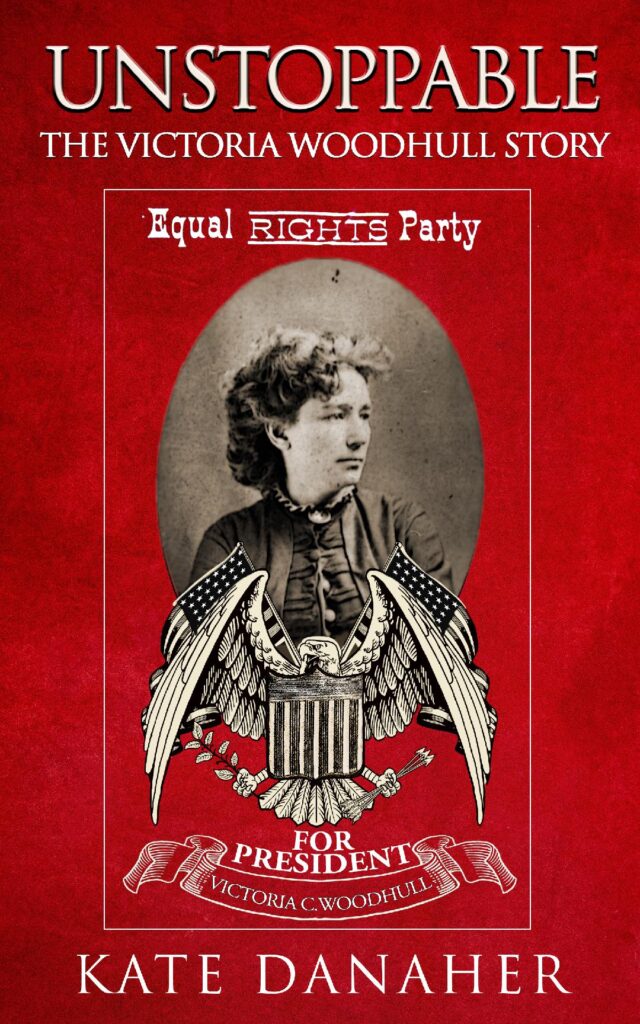
Unstoppable: The Victoria Woodhull Story. Kate Danaher, 2026. This novelist rightfully tossed Barbara Goldsmith’s Other Powers into the trash after being misled by its seductive narrative. Danaher built her story on primary sources, including those shared by the web site Woodhull Rising. Her novel draws from modern scholarship by historian Amanda Frisken, and from biographers Mary Gabriel and Lois Beachy Underhill. Biographer Myra MacPherson was used to flesh out the character of Tennie Claflin. In some respects, Unstoppable is closer to history than some of the biographies. It portrays the Claflin sisters as the itinerant doctresses they actually were, rather than performers in a mythical antebellum traveling medicine show. Most importantly, Victoria is portrayed as a human being, rather than as a symbol of scandal or as a 20th century feminist transported back into the Victorian age.
Well Dressed Lies. Carrie Hayes, 2023. A sequel to The Naked Truth. Oh, the irony in this title! The novel’s premise is that the Claflin sisters are lying about their American past in England to snare husbands — and yet, some of those “lies” were actually invented by biographers, not by the sisters. Hayes adds a well-dressed lie of her own: an invented lesbian affair between Tennessee Claflin and the Duchess of Ackley, a title which does not exist. Some readers enjoyed her lush prose and surreal atmosphere, but the rapid POV shifts between Tennie, Vicky, and Henry James were distracting. Although Hayes was a semi-finalist for the Book Life Prize, her emphasis on aesthetics and prose could leave some readers feeling historically unmoored.
Naked Truth: Or, Equality, The Forbidden Fruit. Carrie Hayes, 2020. Yet another novelist seduced by Barbara Goldsmith. By page 5, Victoria’s sister Tennie is “naked underneath her gossamer shroud” and by the end she’s stepping out of her dress and putting on a robe. The novel covers 1868 to 1877, ending with the sisters’ departure for England. It’s easier to follow than Hayes’s sequel Well Dressed Lies, but the sequel is more original because she finally stripped down Goldsmith’s influence.
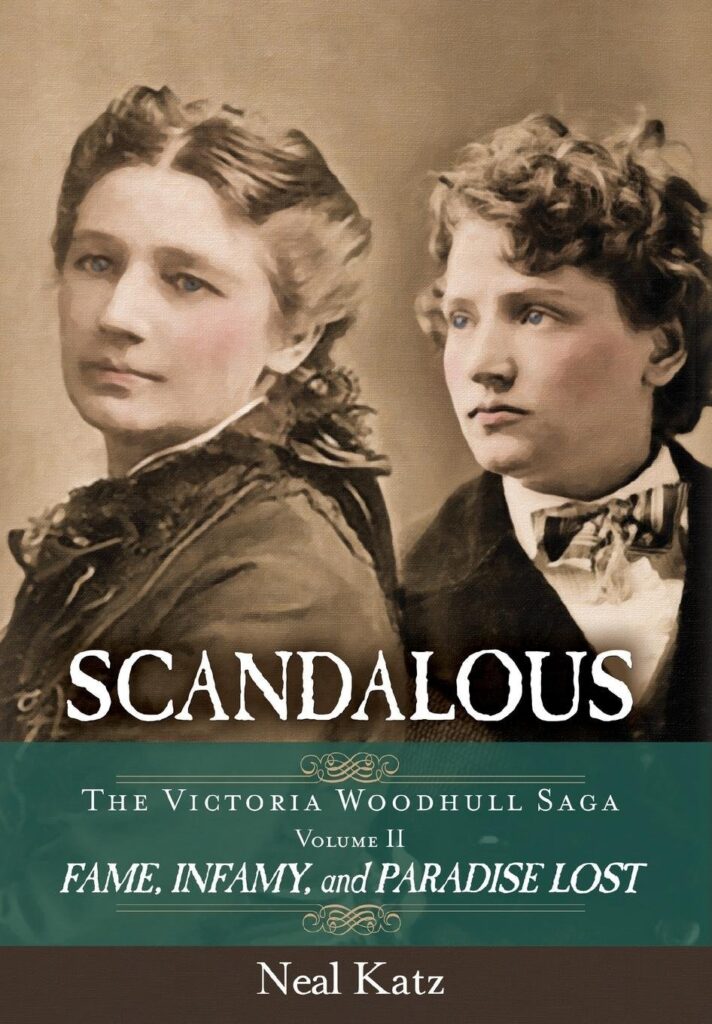
Scandalous: The Victoria Woodhull Saga. Volume Two: Fame, Infamy, and Paradise Lost. Neal Katz, 2018. Volume Three: Audacious, has yet to be released. The author claims he writes “magical realism,” which is an odd fit for historical fiction. Magic is illusion, not reality. But this is consistent with Katz’s postmodern, constructivist approach, where historical fact is ultimately unknowable and narrative feeling overrides evidence. It takes the “historical” out of “historical fiction.” Scandalous covers the years 1870 to 1876. Like Outrageous, it begins with a painful scene, but this time the pain is caused by something more mundane — a bad dream. On the plus side, Katz has no difficulty portraying the lives and struggles of female characters, something some male writers can’t do adequately.
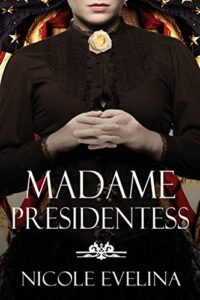
Madame Presidentess. Nicole Evelina, 2016. This novel, like most of the post-1998 novels, appears to be inspired by Barbara Goldsmith’s biography, Other Powers, which is one of the most inaccurate of the Woodhull biographies. The novelist claims her book adheres closely to history but that’s difficult to believe when she has an adult Josie Mansfield performing with Victoria in San Francisco around 1855-1856. In reality Josie Mansfield would’ve been around 9 or younger at the time she informs Victoria that her son is an “idiot.” It would be more accurate to say the novelist adheres closely to Barbara Goldsmith. The one area where the novel diverges from Goldsmith’s interpretation is on the topic of sexual abuse. Evelina chooses to depict Victoria’s father Buck as physically but not sexually abusive, which aligns with Theodore Tilton’s 1871 portrayal. The novel begins with Victoria’s childhood in Homer, Ohio, and ends with her January 1873 speech at Cooper Union in New York City. There’s an afterword by the author that provides a small slice of what happened to Victoria after the novel ends. The author also has notes to explain some of her choices in constructing her narrative the way she did. The book won first place in the 2015 Chaucer Awards for Historical Fiction.
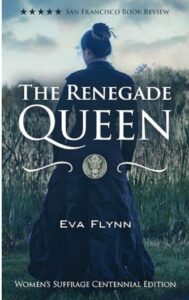
Renegade Queen. Eva Flynn, 2015. The author’s notes say “Victoria’s life is open to interpretation, and I have taken the sympathetic view.” The novel opens with “I was conceived in a whore’s tent at a Methodist Revival.” Imagine what the first sentence would’ve been if she had taken the unsympathetic view! The first chapter of Renegade Queen was obviously inspired by Barbara Goldsmith’s invented account of Victoria’s conception. The Renegade Queen followed Goldsmith’s lead in portraying Buck Claflin as a sexual abuser — which has no basis in fact — and uses sexual abuse as a theme to demonstrate the wretched state of Victorian society. The novel covers Victoria’s life from her conception until she sails to England in 1877. In some respects the book is a romance of Victoria Woodhull and her second husband Colonel Blood. He’s portrayed as the “Hero of Vicksburg.” The novel received the 2016 IPPY Gold Medal for Adult Fiction.

Outrageous: The Victoria Woodhull Saga. Volume One: Rise to Riches. Neal Katz, 2015. Outrageous has an unusual distinction as an example of the phenomenon of spirit channeling. The author genuinely believes that he channeled the spirit of Victoria Woodhull and others while writing this book. The details provided about the birth of Victoria’s daughter Zula suggest that the author was actually channeling the spirit of Barbara Goldsmith who was very much alive at the time this book was written. Both Katz and Goldsmith have Zula born in a tenement at 53 Bond Street. That would be as ridiculous as saying someone was born in a tenement in Trump Tower. Prior to the Civil War Bond Street was the enclave of the rich in New York City. By the time Zula was born the character of the neighborhood was shifting to a middle class and professional neighborhood of doctors and lawyers. The rich were abandoning Bond Street for Fifth Avenue, but the Bond Street neighborhood definitely wasn’t a poor one in 1861. Because this book was inspired by Barbara Goldsmith, it depicts Buck as a sexual abuser in ways some readers may find disturbing. Katz chose to write his novel as a series, which is a good choice as Victoria’s life was so rich and complicated it’s not conducive to a short narrative. The novel has won multiple awards: 2016 Winner of Best New Fiction in the International Book Awards, a Ben Franklin Award from the Independent Book Publishers Association, the Bill Fisher Award for Best First Book by a Publisher, and the IPPY Award for Best Historical Fiction. It was a finalist in the Historical Fiction category of the 2016 Next Generation Indie Book Awards and a second place winner of the IndieReader Discovery Award for best Fiction.
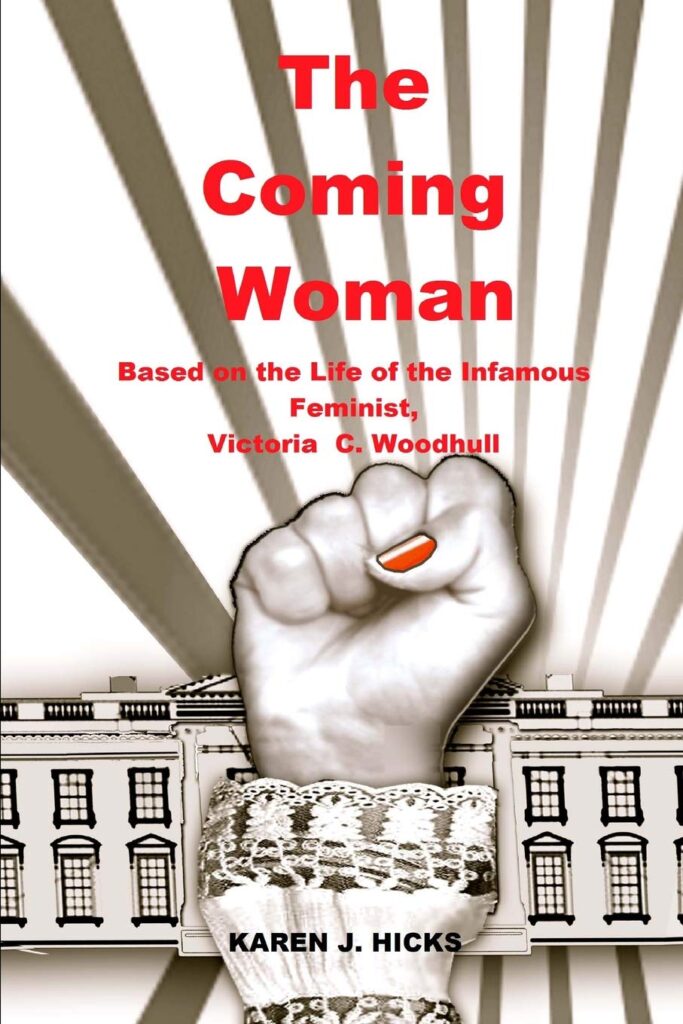
The Coming Woman: A Novel Based on the Life of the Infamous Feminist, Victoria Woodhull. Karen J. Hicks, 2014. Coming Woman begins with Victoria’s announcement of her candidacy for the presidency in 1870 and ends with the Beecher-Tilton scandal. There are flashbacks of her earlier life and a fictionalized epilogue. The writer first learned about Victoria in 1980 before Goldsmith published her book, so it relies less on Other Powers than other more recent novels, although Goldsmith’s influence is still felt.

Bells on Her Toes: The Embellished Memoirs of the Irrepressible Sisters Victoria Woodhull and Tennessee Claflin. [Out of Print] Irving Stanton Elman, 2006. Bells on Her Toes is a wise-cracking novel about the Claflin sisters. Here’s a typical exchange between Dr. Canning Woodhull and Dr. Reuben Buckman Claflin when Dr. Woodhull presents himself as a graduate of the Univeristy of Heidelberg: “Heidleberg University, that sounds familiar–that’s in Germany, ain’t it?” Dr. Woodhull replies, “No, I went to the other one in Heidelberg, Indiana. And where did you obtain your doctorate, sir, if I may ask?””Oxford.” Dr. Woodhull was impressed. “Ah! You studied in England!” “Oxford, Pennsylvania. The Oxford P-a, Academy of Veter’nary Medicine.” The novel doesn’t take itself seriously the way all the other 21st century novels do. If you like this novel, chances are you’ll also like writing style of M. M. Marberry’s biography Vicky.

Gob’s Grief. Chris Adrian, 2002. A story about Gob and Tomo Woodhull, fictional twin sons of Victoria Woodhull.
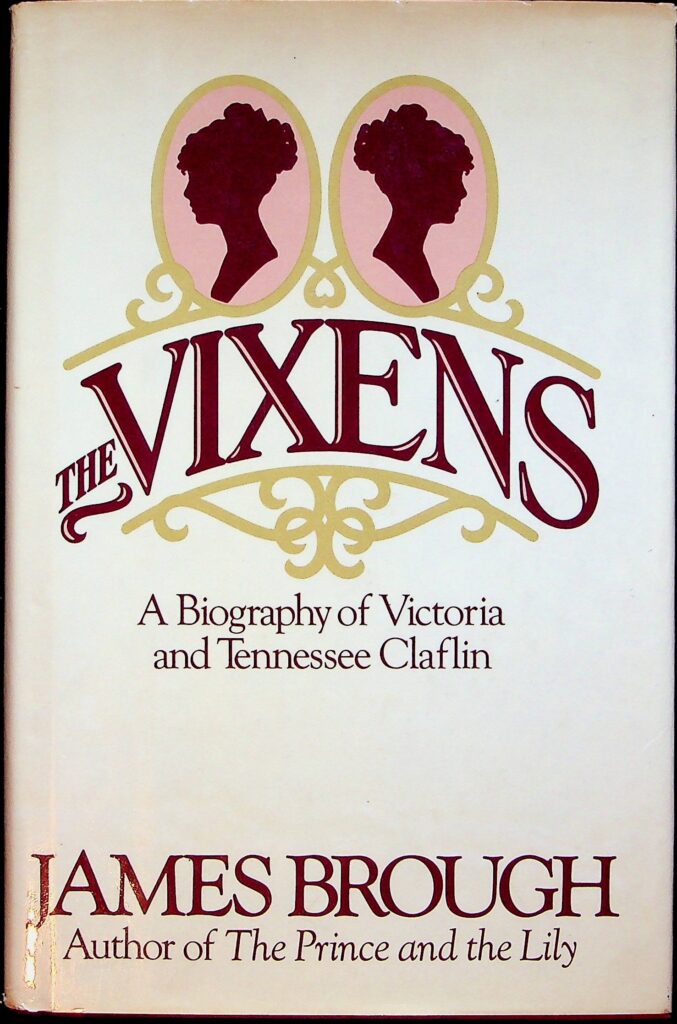
The Vixens: A Biography of Victoria and Tennessee Claflin. James Brough, 1980 & 1981. [Out of Print] Despite Biography in its title, this book is a novel. In the 1980s, an MGM movie treatment written by Julian & Judith Plowden was floating around that contained dialogue from The Vixens. The treatment was shopped to Jessica Lange, Cher, and Jane Fonda, but wisely no one signed up for what can best be described as the Murray Hillbillies.
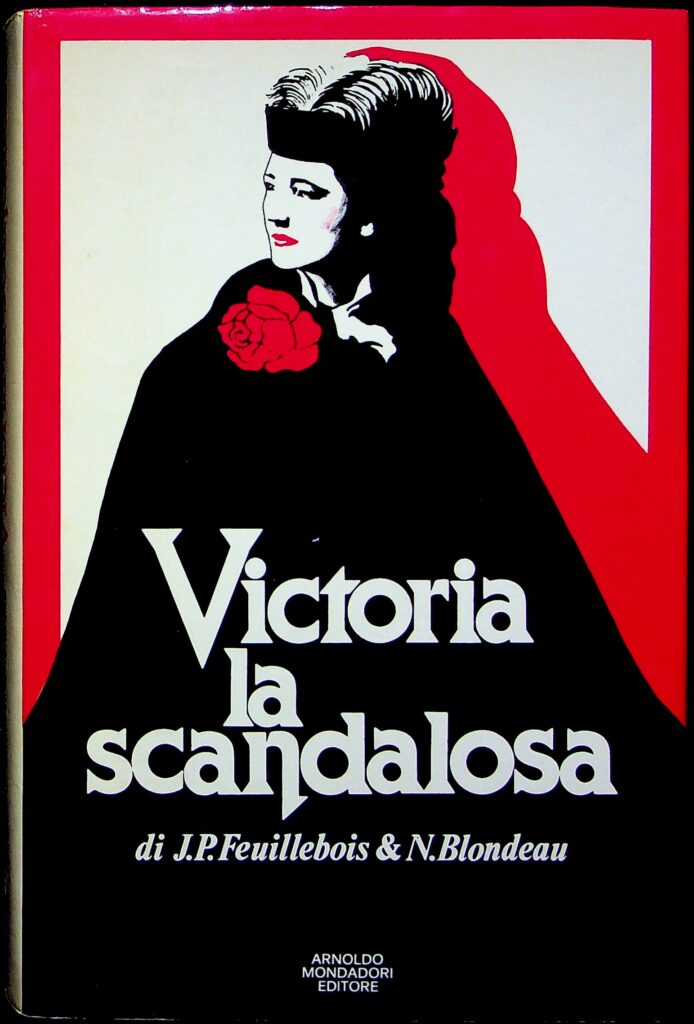
Victoria la scandalosa. J. P. Feuillebois & Nicole Blondeau, 1979 & 1981. Italian.
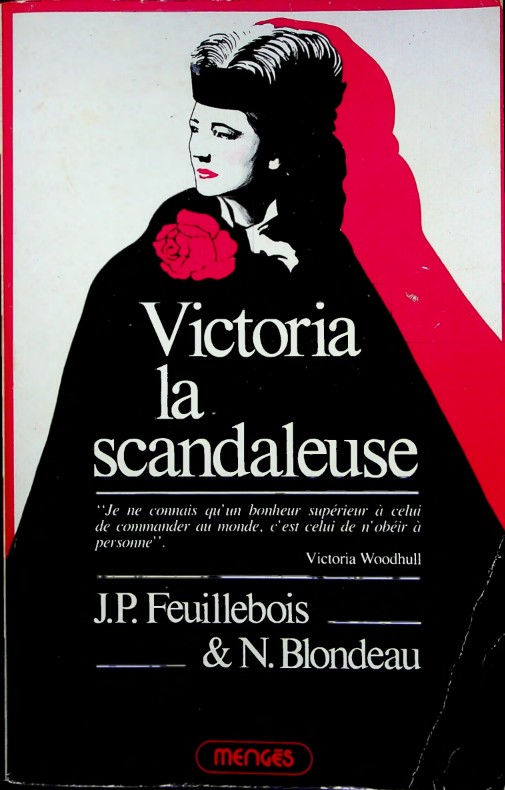
Victoria la scandaleuse. J. P. Feuillebois & Nicole Blondeau, 1979 & 1980. French.
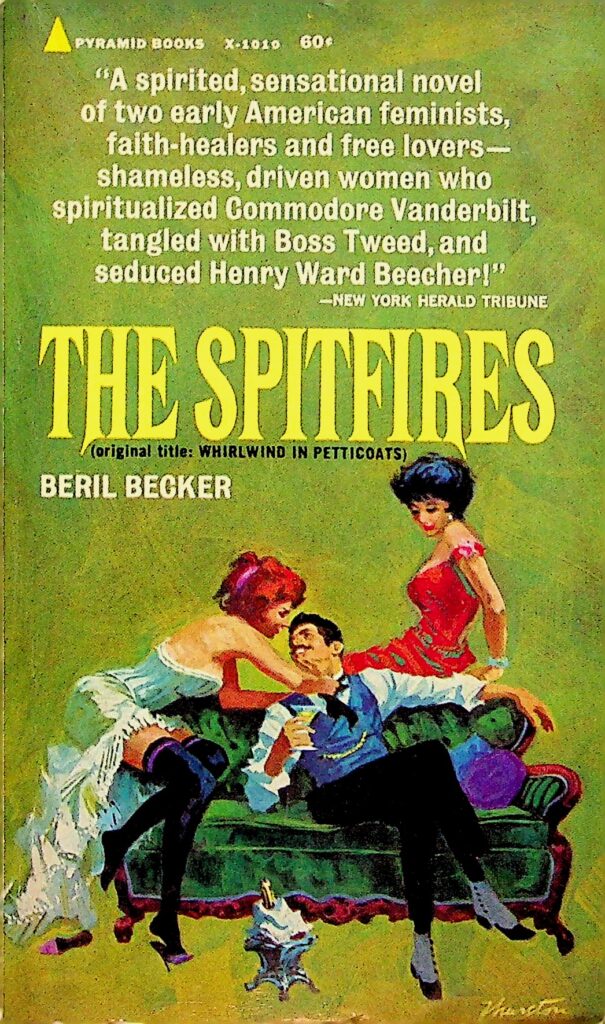
The Spitfires. Beril Becker, 1953 & 1964. Originally released in 1947 as Whirlwind in Petticoats.
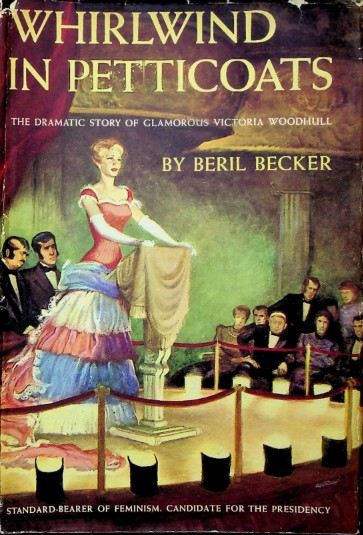
Whirlwind in Petticoats. Beril Becker, 1947. Surprisingly feminist by the standards of the era. In chapter two, there’s a scene at a church revival in Mt. Gilead where Victoria gets caught up with the passion of a stranger, reminiscent of Goldsmith’s channeled scene of Victoria’s conception at at Methodist Camp meeting in Homer.
Online Books Victoria C. Woodhull, A Biographical Sketch Read the first biography ever written about Victoria Woodhull. Published by Theodore Tilton in 1871.
Milo Adams Townsend & the Social Movements of the Nineteenth Century, edited by Peggy Jean Townsend & Charles Walker Townsend III. Chapter on Stanton & Woodhull.
